
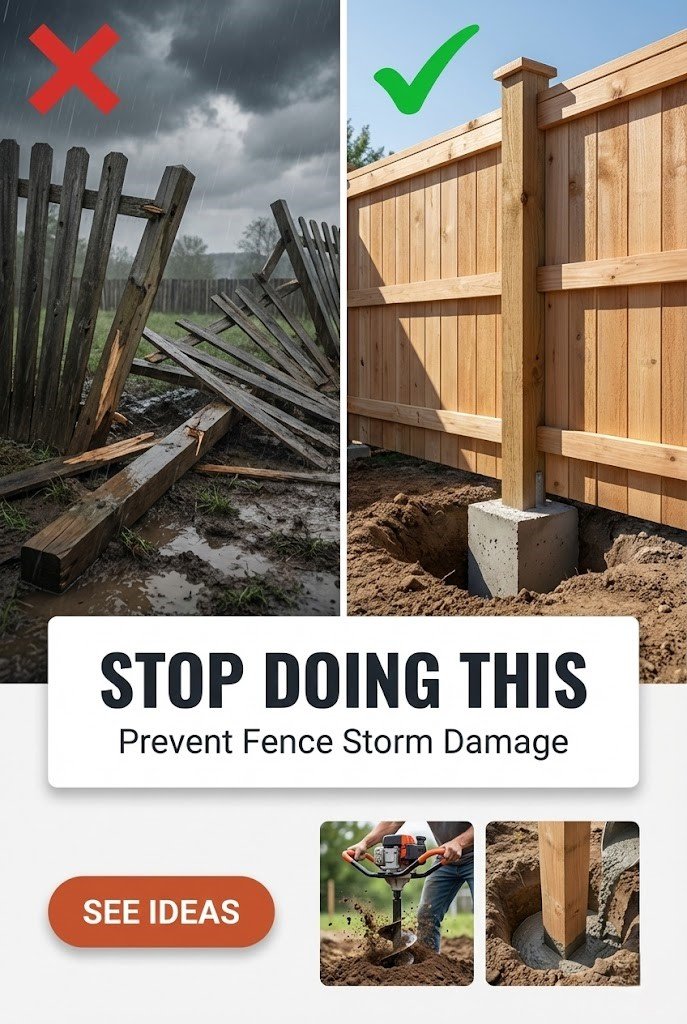
Fences are often the first casualty in a storm. Why? Because a solid privacy fence acts like a massive sail. When the wind hits it, the pressure builds up exponentially, creating thousands of pounds of lateral force that can snap 4×4 posts like twigs or rip concrete footings right out of the ground.
Use our Wind Load Calculator to estimate the force exerted on your fence panels based on wind speed and material type. This tool helps you determine if you need deeper posts, stronger materials, or a more open design.
Fence Wind Load Calculator

How to Use the Wind Load Calculator
- Dimensions: Enter the length and height of a single fence panel (the span between two posts).
- Wind Speed: Enter the maximum gust speed (MPH) common in your area. You can find this on a local wind zone map.
- Material: Select your fence style. This changes the “Drag Coefficient.” A solid vinyl fence catches 100% of the wind (High Drag), while a chain-link fence lets most of it pass through (Low Drag).
Why We Built This: The “Secret Sauce” of Post Depth
The “Secret Sauce” of our tool is the connection between Wind Force and Foundation Depth. Many DIYers follow the old “2 feet deep” rule regardless of the fence height.
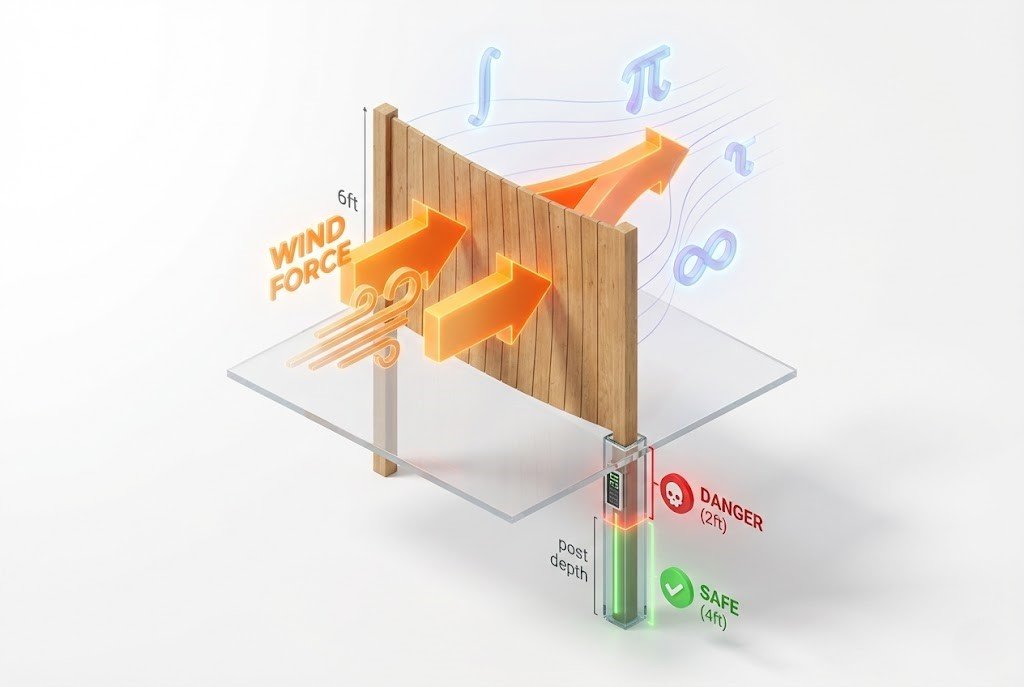
Our calculator analyzes the total pounds of force hitting the panel. If the force exceeds 800 lbs, it automatically suggests increasing your post depth to 1/2 the fence height or switching to thicker 6×6 posts to prevent leverage failure.
Educational Guide: The Physics of Fencing
Wind pressure doesn’t scale linearly; it scales exponentially. This means a 60 MPH wind exerts four times as much force as a 30 MPH wind, not double.
Pressure per Square Foot (PSF)
PSF is calculated using the formula $0.00256 \times V^2$ (where V is velocity in mph).
Example: At 70 MPH, the wind pressure is roughly 12.5 lbs per square foot. On a standard 8×6 solid fence panel (48 sq ft), that equals 600 lbs of force pushing against a single post.
Material Matters: Solid vs. Open
- Solid Privacy (Vinyl/Wood): Highest risk. The wind has nowhere to go. It creates high pressure on the windward side and low pressure (suction) on the leeward side, doubling the stress.
- Shadowbox / Board-on-Board: These designs allow some air to bleed through the gaps, reducing the load by 30-40%.
- Chain Link / Open Rail: The safest option for high-wind zones. The surface area is minimal, so the wind load is negligible.

Frequently Asked Questions
Q: How deep should I set my fence posts?
A: A general rule is 1/3 of the total post length should be underground. However, for high-wind areas or fences taller than 6 feet, setting the post to a depth of 1/2 the exposed height is safer.
Q: Will concrete prevent my fence from blowing over?
A: Concrete adds weight and surface area to the footing, preventing the post from tilting in the soil. However, if the wood post itself is weak (e.g., a rotted 4×4), it will snap right above the concrete line regardless of the footing.
Q: How much wind can a vinyl fence withstand?
A: Most standard vinyl privacy fences are rated for 75-100 MPH winds if installed correctly with aluminum stiffeners in the posts. Without stiffeners, they can fail at much lower speeds.