
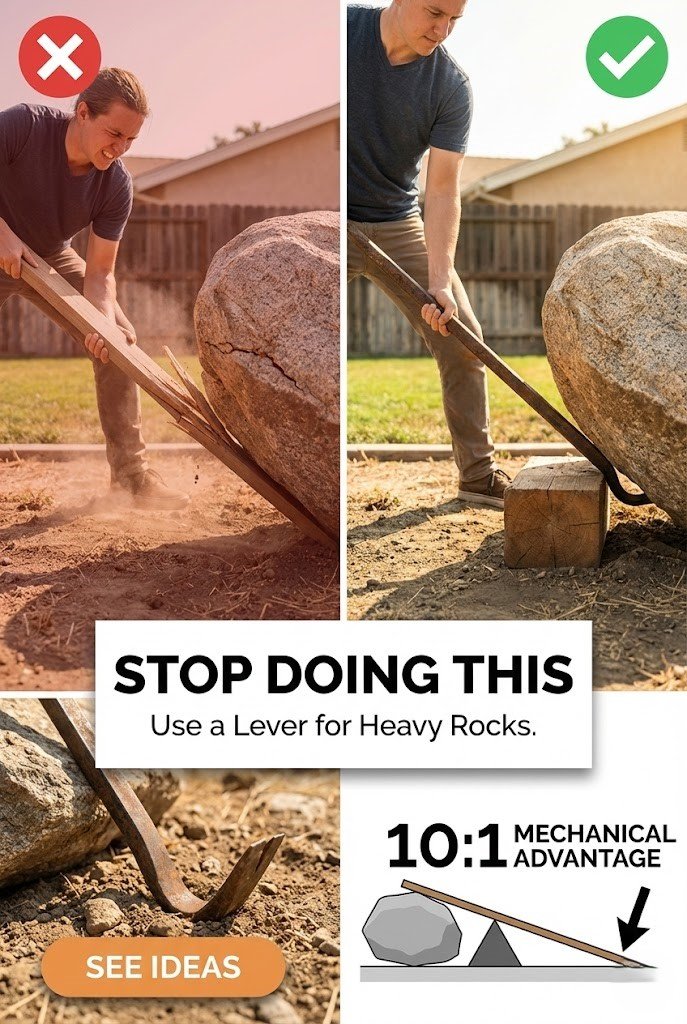
Archimedes once said, “Give me a lever long enough and a fulcrum on which to place it, and I shall move the world.” In the garden, we don’t need to move the world—just that 400-pound granite boulder that is sitting exactly where you want to plant a rose bush.
Moving heavy objects isn’t about brute strength; it’s about physics. Use our Lever Calculator to determine exactly where to place your fulcrum (pivot point) to turn a “impossible lift” into an easy one-handed push.
Lever & Rock Move Calculator
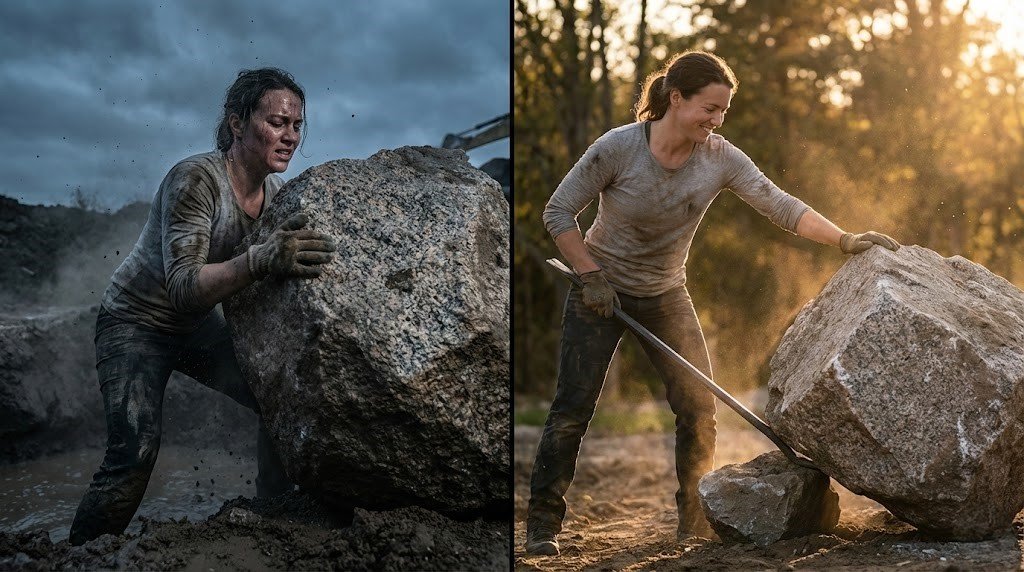
How to Use the Lever Calculator
- Object Weight: Estimate the weight of the rock or stump. (Tip: A 1-foot diameter granite rock weighs approx. 170 lbs).
- Total Bar Length: The length of your pry bar, digging bar, or 2×4 timber.
- Fulcrum Distance: The distance from the object to the pivot point (the log or brick you are pivoting on). The closer this is to the object, the easier the lift.
Why We Built This: The “Safety Factor”
The “Secret Sauce” of our tool is the Material Safety Check. Calculating force is easy, but knowing the breaking point of your tool is critical.
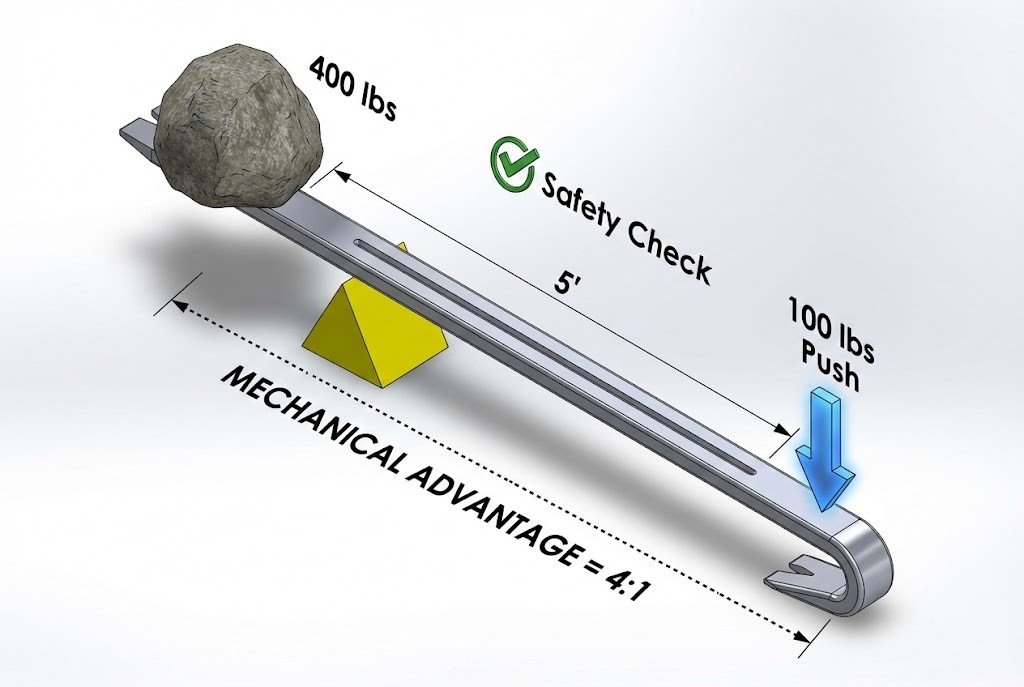
If you try to lift a 500lb rock using a wooden 2×4 as a lever, the wood will likely snap before the rock moves, sending splinters flying. Our calculator flags high-tension loads and suggests when to switch from wood to a solid steel digging bar.
Educational Guide: The Class 1 Lever
In a Class 1 lever, the fulcrum sits between the load (rock) and the effort (you). This allows you to trade distance for force.
Mechanical Advantage (MA)
This is the multiplier of your strength. An MA of 4:1 means that for every 10 lbs you push down, the bar lifts 40 lbs up.
Formula: $\text{MA} = \frac{\text{Length of Effort Arm}}{\text{Length of Load Arm}}$
To increase your advantage, move the fulcrum closer to the rock.
Estimating Rock Weight
Don’t guess—calculate.
- Sandstone/Limestone: ~150 lbs per cubic foot.
- Granite/Basalt: ~175 lbs per cubic foot.
If a rock is roughly 2ft x 2ft x 1ft, that is 4 cubic feet. If it’s granite, that’s $4 \times 175 = 700 \text{ lbs}$.
Frequently Asked Questions
Q: Can I use a shovel as a lever?
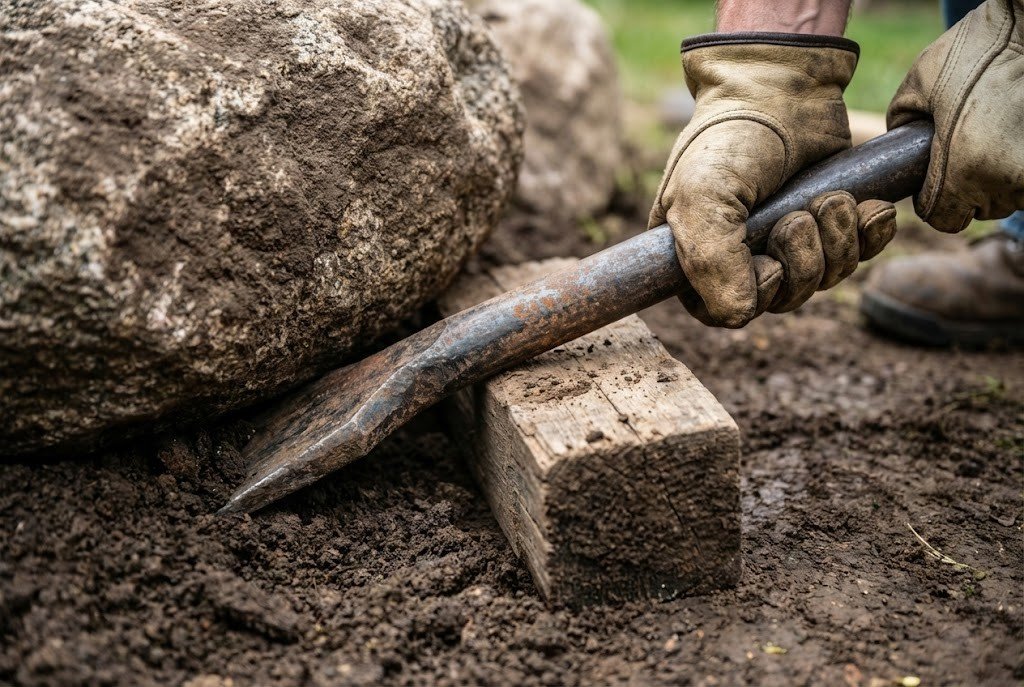
A: No! Shovels are designed for digging, not prying. The neck of a shovel is the weak point and will snap under very little leverage load. Use a digging bar (spud bar) or a mattock.
Q: What should I use as a fulcrum?
A: A solid block of wood, a brick, or another flat rock works well. Ensure it is stable and won’t sink into the soft soil. If the ground is soft, place a plywood board under the fulcrum to distribute the pressure.
Q: How do I move the rock once it’s lifted?
A: Lift it just high enough to slide a heavy-duty dolly, a piece of plywood, or pipes (to roll it) underneath. Never put your fingers under a suspended rock.