
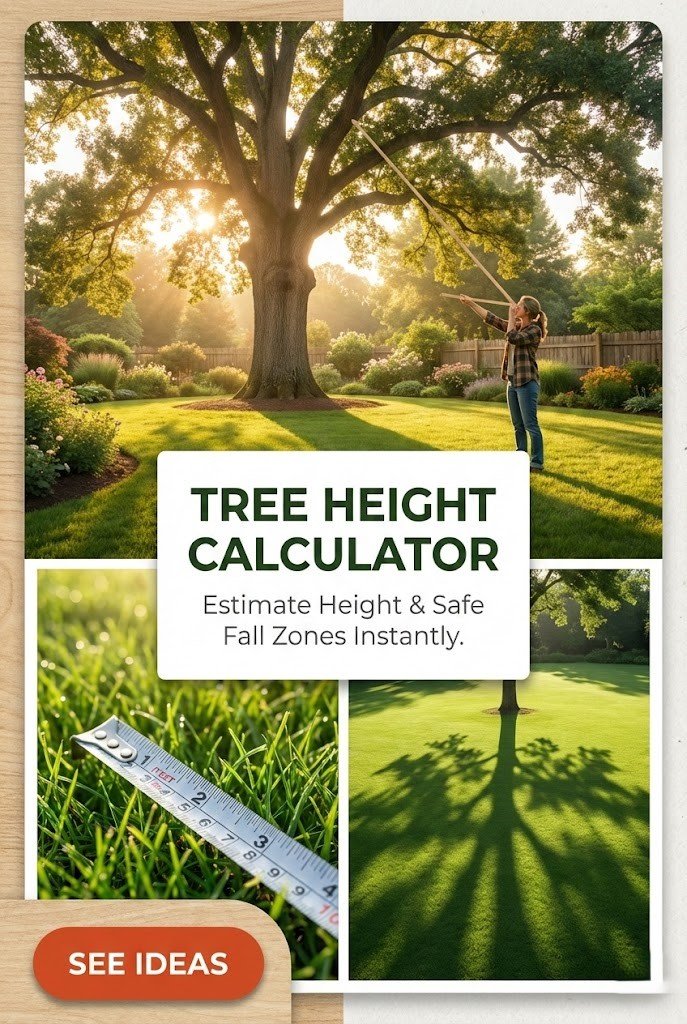
Whether you are planning to fell a dangerous tree near your house or just curious about the age of an old Oak in your backyard, knowing the height of a tree is essential. But you don’t need a bucket truck or climbing gear to get an accurate measurement. Using simple geometry and tools you already have (a stick or your own shadow), you can estimate tree height with surprising accuracy.
Use our Tree Height Estimator to calculate the vertical height and determining the “Drop Zone” safety radius before you start cutting.
Tree Height Estimator
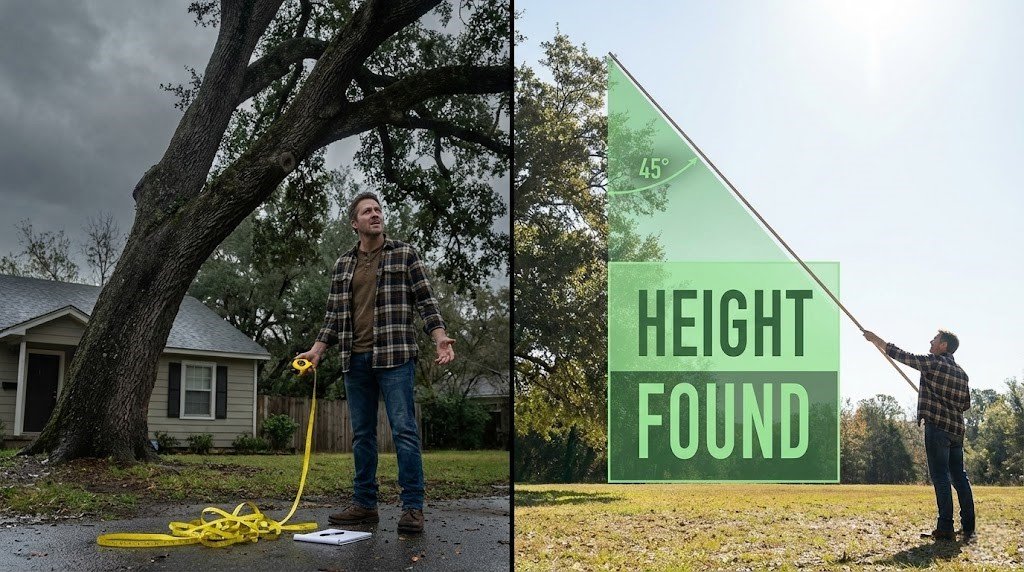
How to Use the Tree Height Calculator
Our tool offers two distinct methods depending on the weather and your available tools.
Method 1: The Stick Method (45° Angle)
This method works on the principle of an Isosceles Right Triangle.
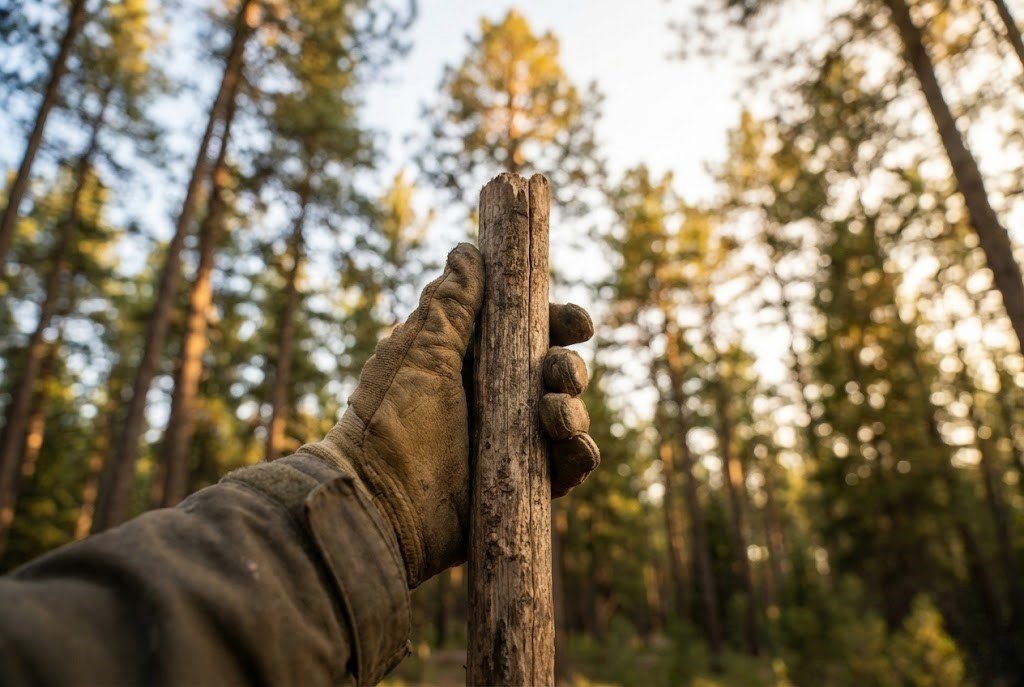
- Find a stick that is the exact length of your arm (from shoulder to hand).
- Hold the stick vertically at arm’s length (90° to your arm).
- Walk backward away from the tree until the top of the stick lines up with the top of the tree, and the bottom of the stick lines up with the base.
- Measure the distance from your feet to the tree.
- Enter that distance + your eye height into the calculator.
Method 2: The Shadow Method (Sunny Days)
This method uses similar triangles and is extremely accurate on sunny days.
- Measure the length of the tree’s shadow.
- Immediately measure the length of your own shadow.
- Enter your own height.
- The calculator uses the ratio to solve for the tree’s height.
Why We Built This: The “Secret Sauce” of Safety
The “Secret Sauce” of our tool is the Safety Drop Zone Calculation. Knowing the height is interesting, but knowing the “Fall Radius” saves lives. If a tree is 80 feet tall, it won’t just hit things 80 feet away—debris can bounce and shatter further.
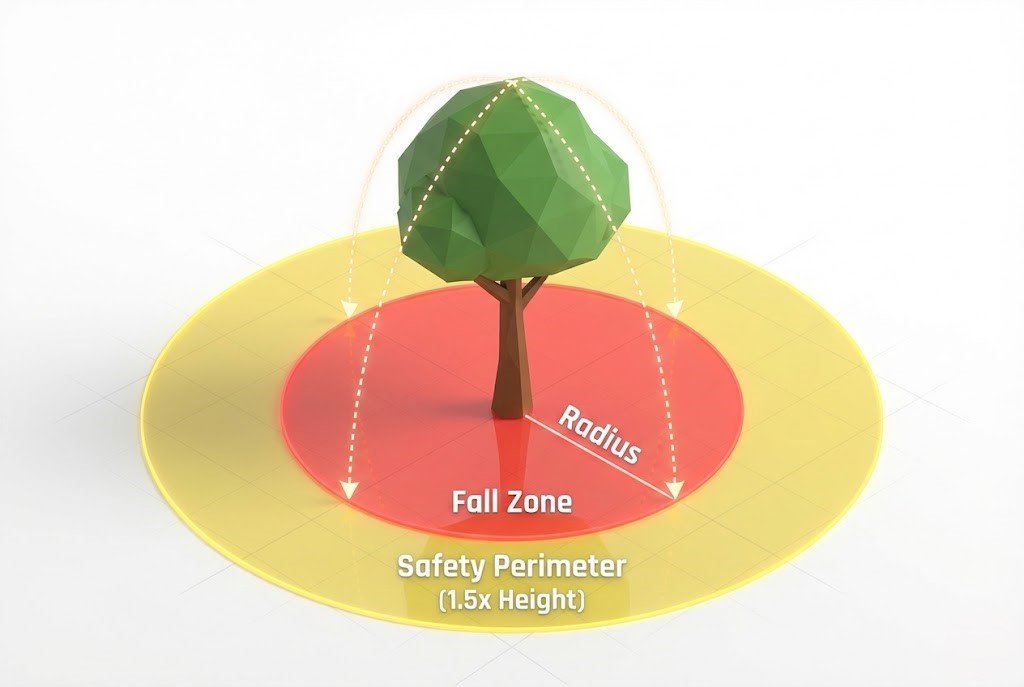
Our tool automatically calculates a safety perimeter (1.5x height) so you can clear the area of cars, pets, and people before any chainsaw work begins.
Educational Guide: Factors Affecting Tree Height
Trees stop growing vertically due to hydraulic limitation—eventually, they can’t pump water any higher against gravity.
- Species Cap: A Silver Maple might max out at 80ft, while a White Pine can reach 150ft+.
- Soil Depth: Shallow roots often lead to shorter, wider trees as they prioritize stability over height.
- Competition: Trees in a dense forest grow taller and straighter to compete for sunlight compared to a standalone tree in a field.
Frequently Asked Questions
Q: How accurate is the Stick Method?
A: If done correctly on flat ground, it is usually accurate within 5-10%. If the tree is leaning or on a slope, the accuracy decreases significantly.
Q: What if the tree is on a hill?
A: The calculations assume flat ground. If the tree base is higher than your feet, the calculated height will be too short. If the base is lower, it will be too tall.
Q: Is there a digital tool for this?
A: Yes, forestry professionals use Laser Rangefinders (Hypsometers) which bounce a laser off the top and bottom of the tree to calculate height using an internal inclinometer.