
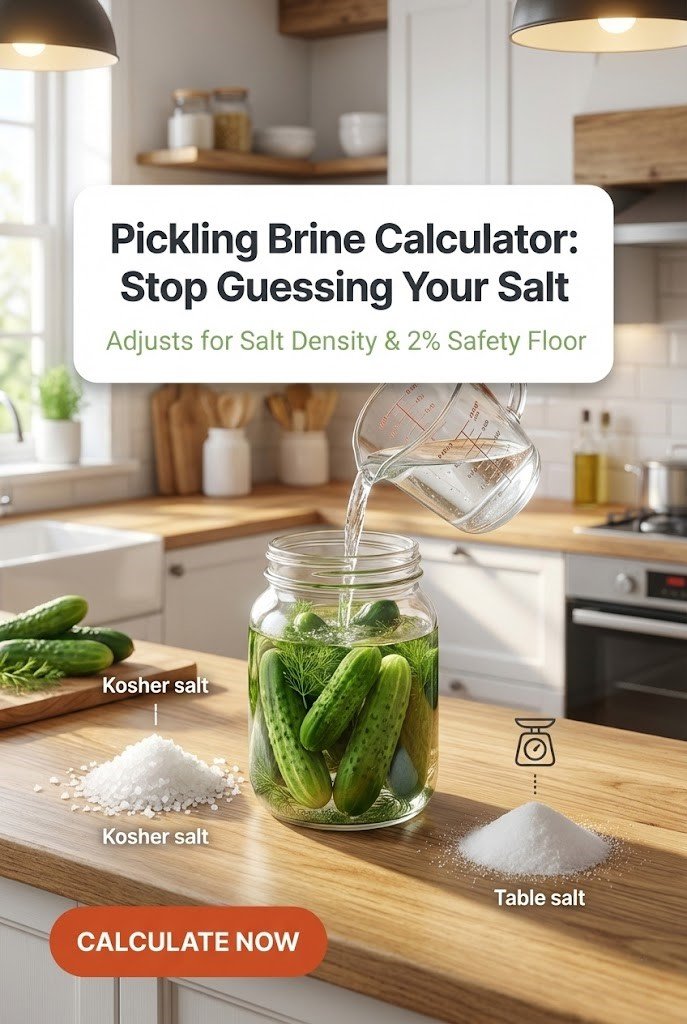
The secret to a crisp, shelf-stable pickle isn’t just the vinegar—it’s the chemistry of the brine. Whether you are “quick-pickling” cucumbers from your garden or embarking on a month-long wild fermentation of sauerkraut, getting your salt percentage right is a matter of both flavor and food safety. Too little salt allows bad bacteria to thrive; too much salt kills the beneficial lactobacillus that creates that signature tang.
Use our Brine Calculator to accurately measure salt by volume or weight. Our tool accounts for the different densities of Table Salt vs. Kosher Salt, ensuring your measurements are precise every time.
Pickling Brine Calculator
How to Use the Brine Calculator
- Water Volume: Enter how many cups of water you are using for your brine base.
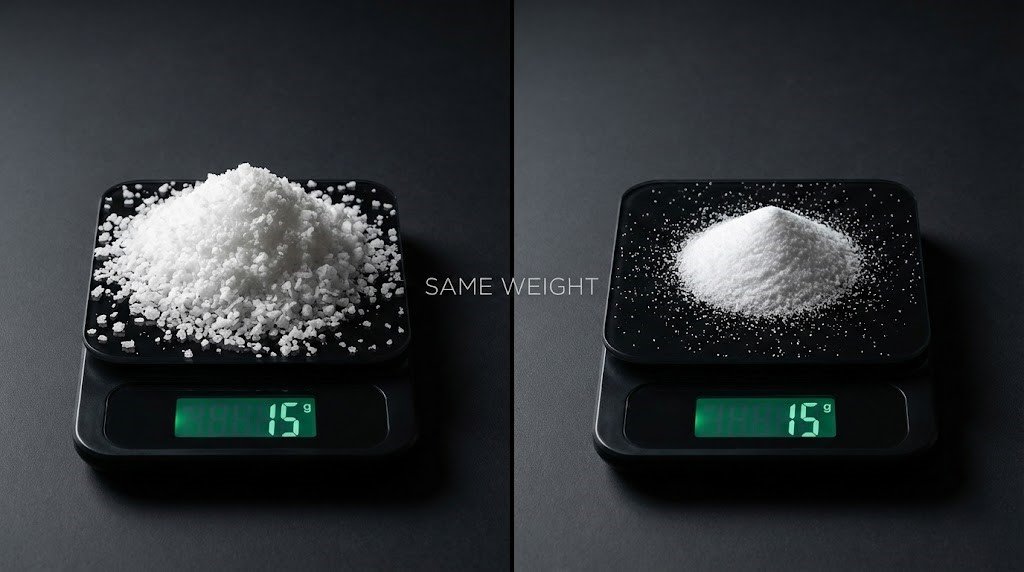
- Salt Type: This is critical! A tablespoon of fine table salt weighs nearly twice as much as a tablespoon of flaky Diamond Crystal Kosher salt. Select your specific brand for accuracy.
- Preservation Method:
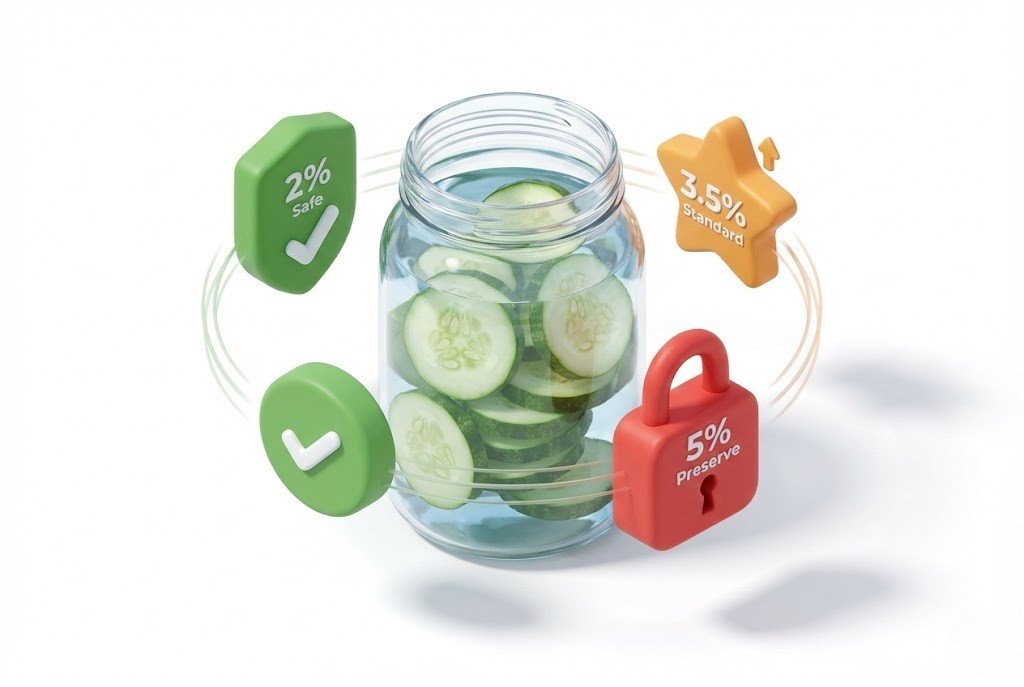
- 2% (Ferment): Ideal for half-sour pickles and active ferments.
- 3.5% (Standard): The "Goldilocks" zone for most garden vegetables and refrigerator pickles.
- 5% (Preserve): High-salt environment for long-term storage or peppers.
Why We Built This: The "Secret Sauce" of Salt Density
Most recipes say "add 2 tablespoons of salt," but they don't tell you which salt they used. Because salt crystals vary in size, measuring by volume (spoons) is notoriously inaccurate. The "Secret Sauce" of our tool is the Density Adjustment Database.
By selecting your salt type, our calculator adjusts the mathematical conversion from grams (weight) to tablespoons (volume), so you don't accidentally over-salt your batch just because you switched brands.
Educational Guide: Salt and Food Safety
In pickling and fermentation, salt performs a process called osmosis. It draws water and sugars out of the vegetable cells and creates an environment where only salt-tolerant, beneficial bacteria can survive.
Table Salt vs. Pickling Salt
While you can use table salt, it often contains "anti-caking" agents and iodine. These won't necessarily hurt you, but they will turn your brine cloudy and may give your pickles a slightly metallic or bitter aftertaste. For the best results, use Pickling Salt or a high-quality Kosher Salt without additives.
The 2% Safety Floor
For wild fermentation (non-vinegar pickling), 2% salt by total weight is considered the minimum safety threshold. Anything lower risks the growth of clostridium botulinum or surface molds. If you are doing a "quick pickle" with a 1:1 ratio of water and vinegar, the acidity of the vinegar provides the safety, allowing for more flexibility in salt levels.
Frequently Asked Questions
Q: Can I use sea salt for pickling?
A: Yes, as long as it is pure sea salt without added minerals or anti-caking agents. Fine sea salt has a similar density to table salt.
Q: Why did my pickle brine turn cloudy?
A: This is usually caused by using salt with anti-caking agents, or it is a natural sign of active fermentation. If you used vinegar and the brine is cloudy, it may be due to minerals in your hard tap water.
Q: How long does brine last?
A: You can mix a large batch of brine and store it in the fridge indefinitely. Since it is a high-salt environment, it will not spoil, though we recommend mixing fresh for each harvest to ensure perfect ratios.