
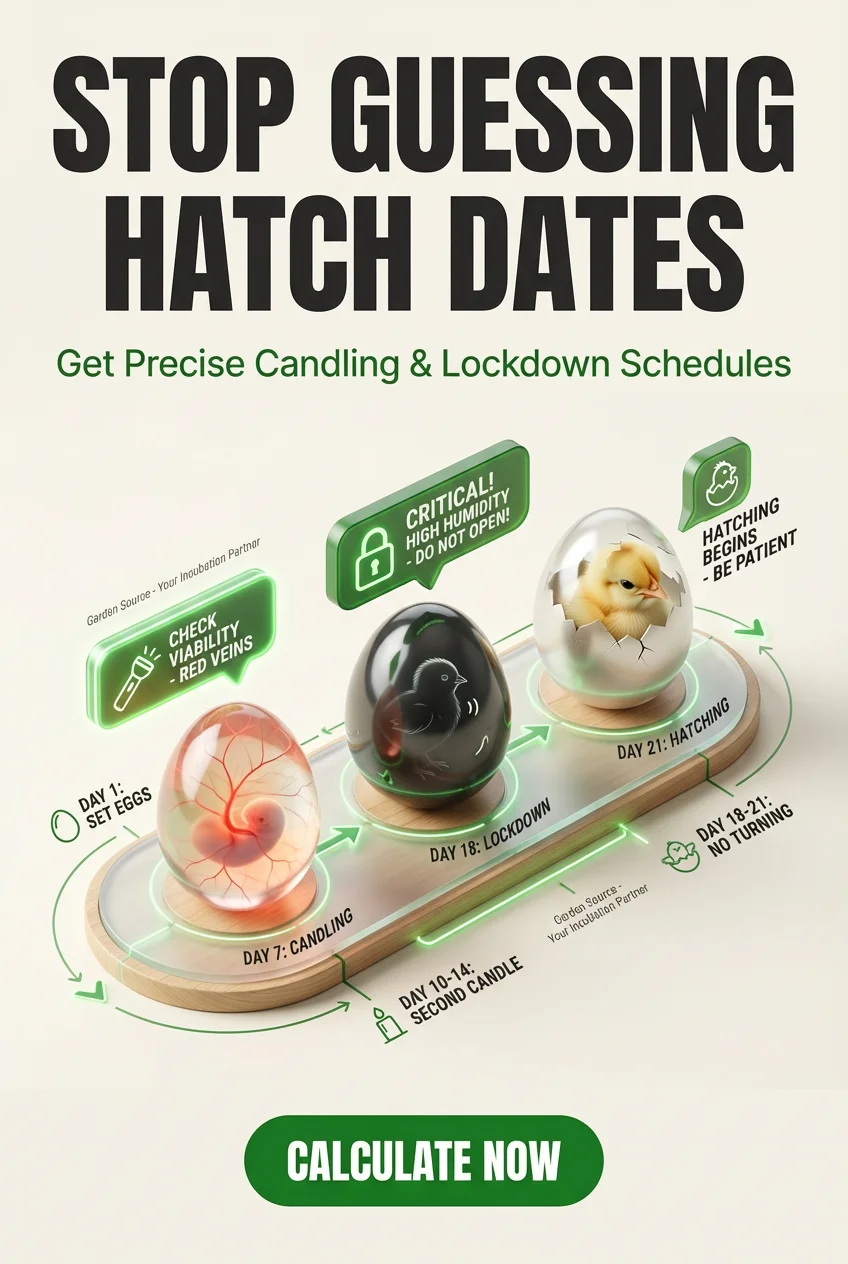
Incubating eggs is one of the most rewarding experiences for any backyard gardener or small-scale farmer. However, success depends on meticulous timing. Missing your Lockdown Date or failing to candle your eggs at the right time can lead to poor hatch rates and “dead-in-shell” chicks. Whether you are hatching chickens, ducks, or quail, knowing exactly when to adjust your incubator settings is critical.
Use our Hatch Date Calculator to generate a complete timeline for your incubation cycle, including candling schedules and the all-important lockdown phase.
Egg Incubation Calculator
How to Use the Hatch Date Calculator
- Date Set: Select the day you placed your eggs into the warmed incubator.
- Species: Choose your bird type. Incubation periods vary wildly; for instance, a Coturnix Quail takes only 18 days, while a Goose requires 30.
- Result: The calculator will output your expected hatch date and highlight the dates for candling and lockdown.
Why We Built This: The “Secret Sauce” of Successful Hatches
Most basic calendars only tell you the final hatch date. Our “Secret Sauce” is the automated Lockdown and Candling Schedule. Three days before hatching, eggs enter the “Lockdown” phase—this is when you must stop turning the eggs and increase humidity to prevent the chick’s membrane from drying out (shrink-wrapping).
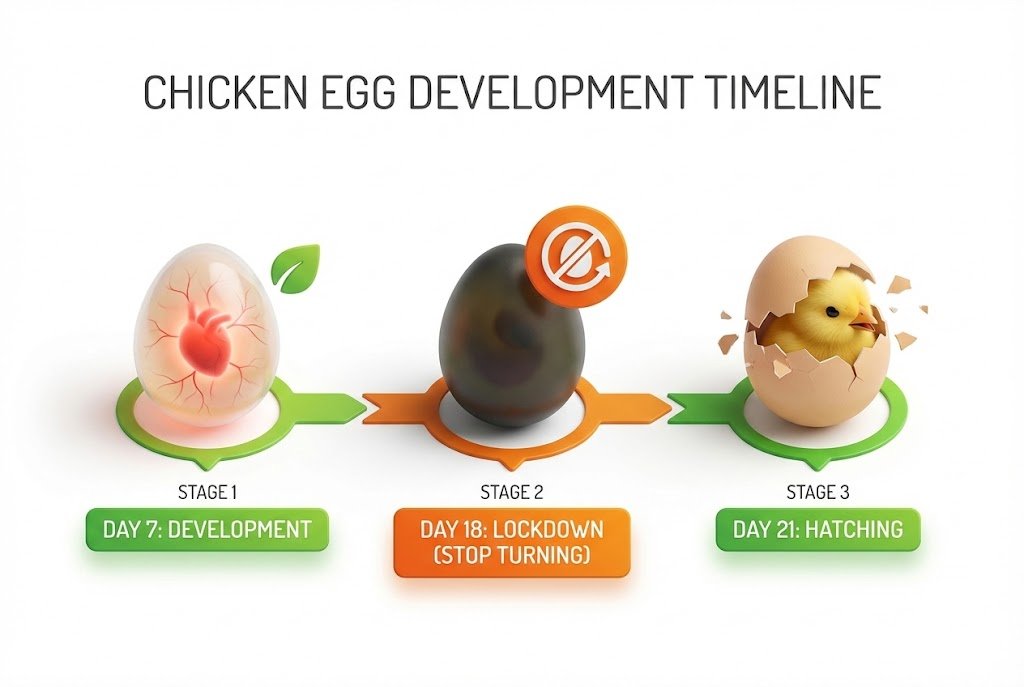
Our tool also provides specific Candling Dates (Day 7 and Day 14) so you can identify and remove non-viable “clear” eggs before they spoil and explode in your incubator.
Educational Guide: Mastering the Incubation Cycle
For a successful hatch, you must manage three key factors: Temperature, Humidity, and Turning.
1. Candling (Days 7 & 14)
Candling involves shining a bright light through the egg to see the developing embryo. By Day 7, you should see a network of veins radiating from a small dark spot (the heart). If the egg is “clear,” it is infertile and should be removed. By Day 14, the egg should be mostly dark as the chick grows.
2. Turning the Eggs
In nature, a broody hen turns her eggs dozens of times a day. This prevents the embryo from sticking to the shell membrane. You should turn your eggs at least 3–5 times per day until you reach the Lockdown Date.
3. The Lockdown Phase
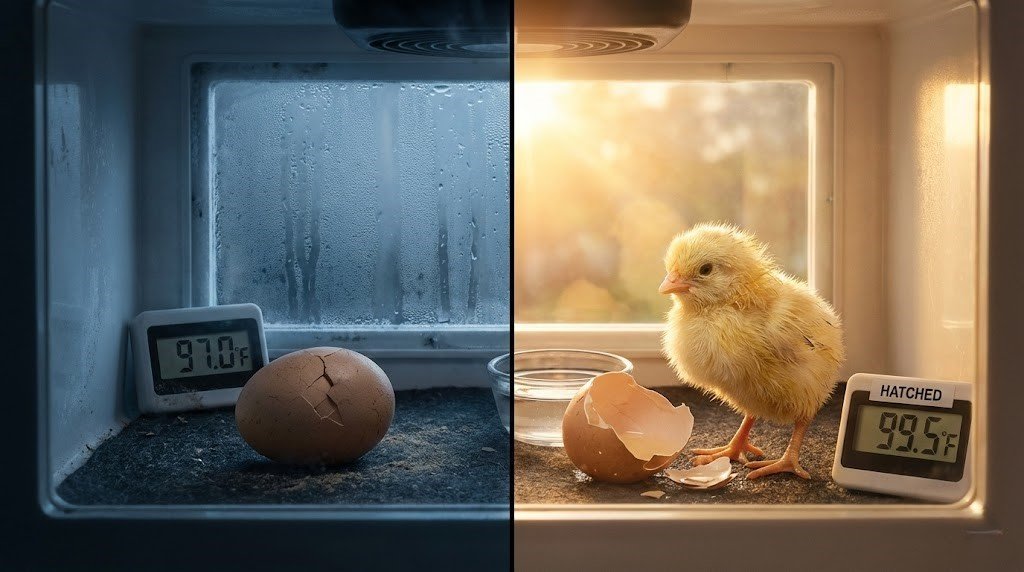
During the final 72 hours, the chick moves into the “hatching position.” Opening the incubator during this time causes a sudden drop in humidity, which can “shrink-wrap” the chick inside the shell, making it impossible for them to break out. Keep the lid closed!
Frequently Asked Questions
Q: My eggs didn’t hatch on Day 21, should I throw them away?
A: No! If your incubator temperature was slightly low, the hatch can be delayed by 24–48 hours. Continue to wait until Day 23 or 24 before giving up, especially if you see the eggs “wiggling.”
Q: What is the ideal temperature for chicken eggs?
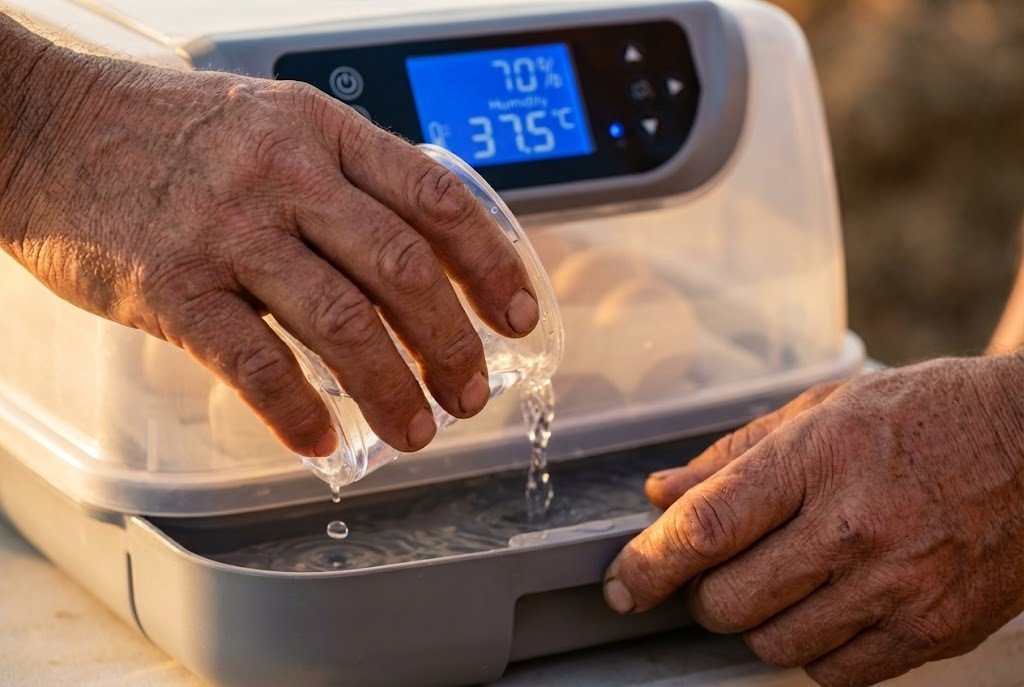
A: For forced-air incubators (with a fan), the gold standard is 99.5°F (37.5°C) throughout the entire cycle.
Q: Why did my chicks hatch but then die in the shell?
A: This is usually a humidity issue. If humidity is too high during the first 18 days, the air cell doesn’t grow large enough, and the chick drowns when it tries to take its first breath. If humidity is too low during lockdown, the chick gets stuck in the membrane.