
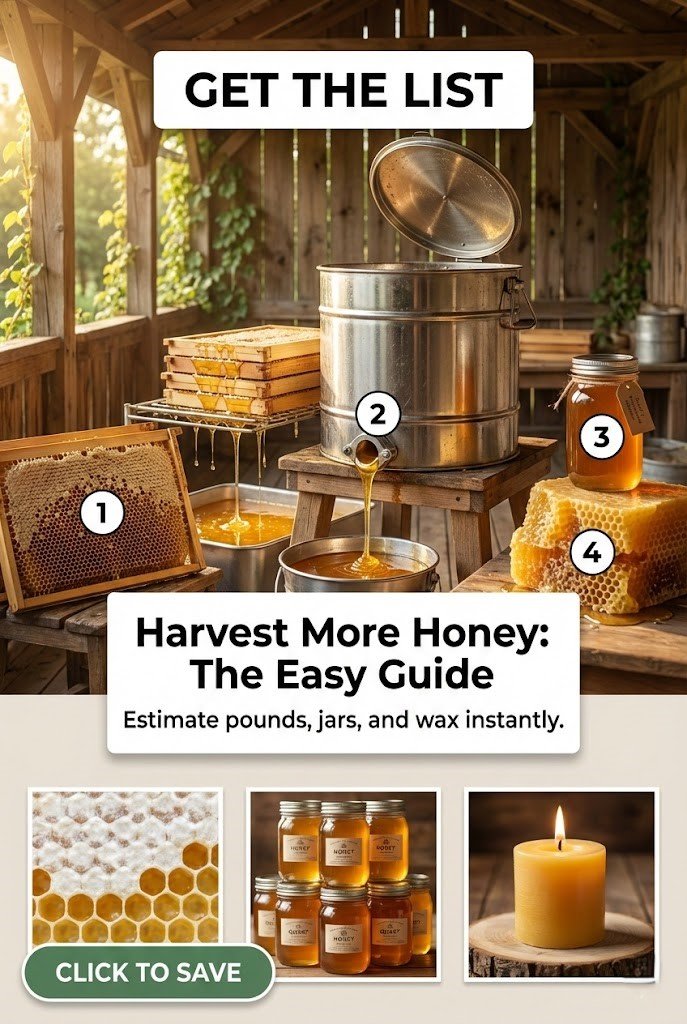
For a beekeeper, harvest day is the culmination of months of hard work. But before you fire up the extractor, you need a plan. How many jars do you need to buy? Do you have enough storage buckets? Guessing can lead to a sticky mess or a wasted trip to the supply store.
Use our Honey Yield Calculator to translate your capped frames into total pounds of honey, wax byproducts, and total jar counts. Whether you use Deep, Medium, or Shallow supers, this tool provides a professional-grade estimate for your bottling needs.
Beehive Honey Yield Calculator

How to Use the Honey Yield Calculator
- Number of Capped Frames: Only count frames that are at least 90% capped with wax. Uncapped honey has too much moisture and may ferment.
- Frame Size:
- Deep: Usually found in the brood nest, but sometimes used for honey (6-7 lbs yield).
- Medium: The most common size for honey supers (3-4 lbs yield).
- Shallow: Lightweight and easy to handle (2-2.5 lbs yield).
- Extraction Efficiency: No extractor gets 100%. Manual crushing and straining is usually around 80%, while a centrifugal extractor can reach 90-95%.
Why We Built This: The “Secret Sauce” of Byproducts
The “Secret Sauce” of our tool is the Beeswax Estimator. Many new beekeepers throw away the wax cappings, not realizing that for every 60 lbs of honey, you can harvest nearly a pound of pure beeswax.
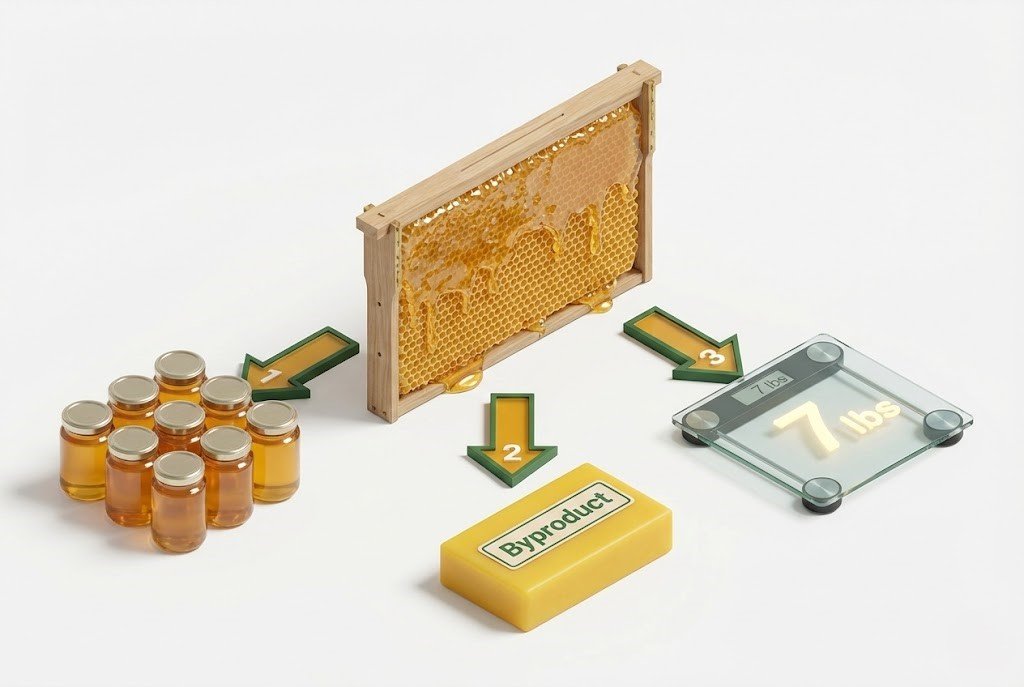
Our tool also provides a Jar Conversion—automatically switching your pounds into Pint and Quart jar counts—so you can order your glassware with confidence.
Educational Guide: Factors Affecting Honey Production
A single honeybee produces only about 1/12th of a teaspoon of honey in its lifetime. To fill one medium super, your hive needs a healthy population and a strong “nectar flow.” [Image of the internal anatomy of a honey bee]
Understanding Nectar Flow
Honey production isn’t constant. It peaks during “flows”—times when specific local plants (like clover, basswood, or wildflower) are blooming in abundance. During a heavy flow, a strong hive can fill an entire medium super in just one week. Conversely, during a “dearth” (hot, dry periods with no blooms), bees may actually eat their stored honey to survive.
When to Harvest
Bees fan nectar with their wings to reduce moisture content. Once it reaches below 18.6% moisture, they “cap” it with a thin layer of wax. Only harvest capped honey. If you extract liquid nectar that hasn’t been cured by the bees, it will spoil and ferment in the jar.
Frequently Asked Questions
Q: How many pounds of honey are in a 5-gallon bucket?
A: A standard 5-gallon bucket holds approximately 60 pounds of honey.
Q: How much does 1 pint of honey weigh?
A: Honey is much denser than water. While a pint of water is “a pound the world around,” a pint of honey weighs approximately 1.5 pounds (24 oz).
Q: What should I do with the wax cappings?
A: Melt them down! Cappings wax is the highest quality, whitest wax in the hive. It is perfect for making cosmetic-grade lip balms, salves, or high-end candles.