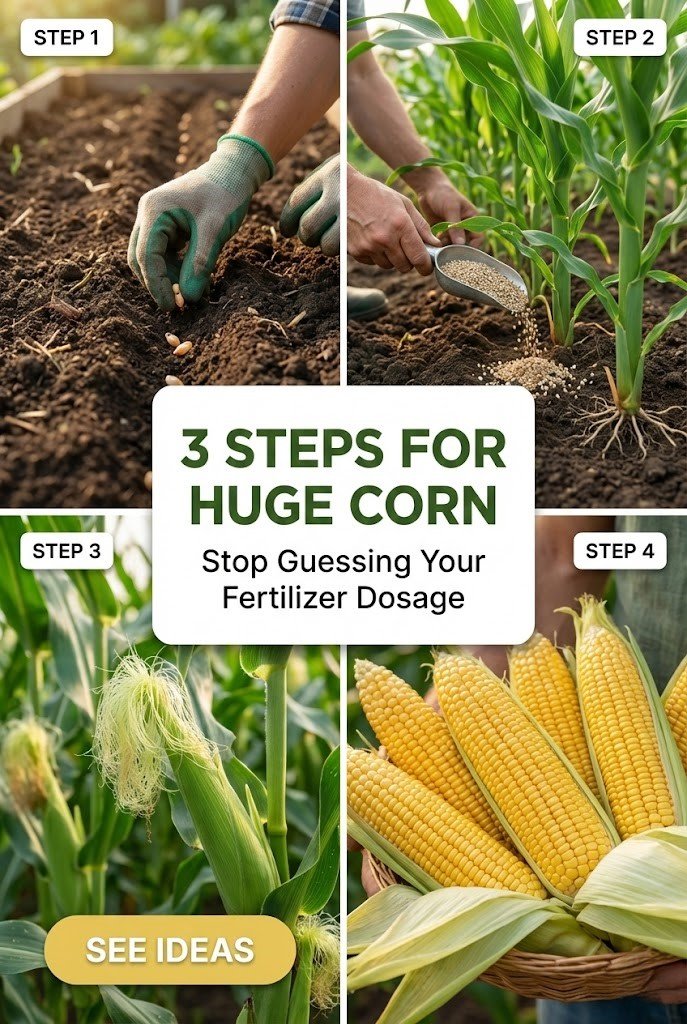
Corn is the “hungry teenager” of the vegetable garden. It grows rapidly and requires massive amounts of energy to produce sweet, full ears. If your corn stalks are yellowing at the bottom or your cobs are small and poorly filled, the culprit is almost certainly a nitrogen deficiency. However, dumping all the fertilizer at once is a mistake—it washes away before the plant can use it.
Use our Corn Nitrogen Calculator to determine exactly how much fertilizer to apply at the three critical growth stages: Pre-Planting, Knee-High (V6), and Tasseling.
Corn Nitrogen Calculator

How to Use the Nitrogen Calculator
- Dimensions: Enter the length of your rows and how many rows you have. We assume a standard row width of 3 feet.
- Growth Stage: Select the current status of your corn.
- Pre-Plant: Preparing the soil before sowing.
- Knee-High: The most critical feeding time (when plants are 12-18″ tall).
- Tasseling: When the silks appear.
- Fertilizer N-Value: Look at the first number on your fertilizer bag (N-P-K). For Blood Meal, this is usually 12. For Urea, it is 46.
Why We Built This: The “Secret Sauce” of Split Application
The “Secret Sauce” of our tool is the Stage-Based Logic. Novice gardeners often apply 100% of the nitrogen at planting time. By the time the corn is knee-high (when it needs nitrogen the most to build the stalk and cob), the rain has washed the nutrients away.
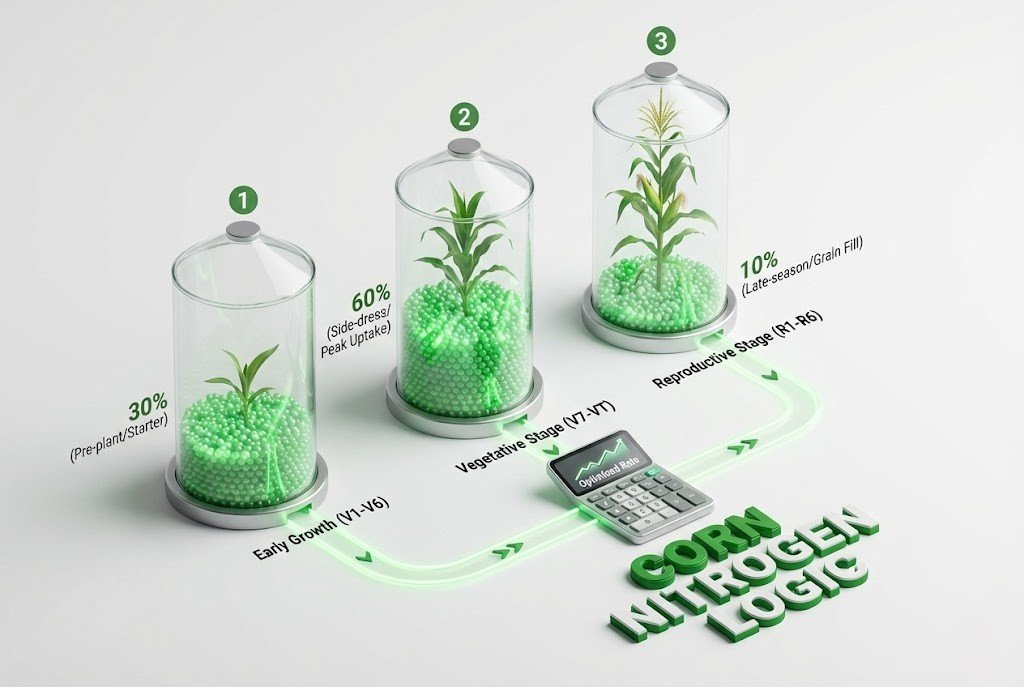
Our calculator splits the dosage: 30% early, 60% at knee-high, and 10% at tassel. This mirrors commercial farming practices scaled down for the home gardener.
Educational Guide: How to “Side-Dress” Corn
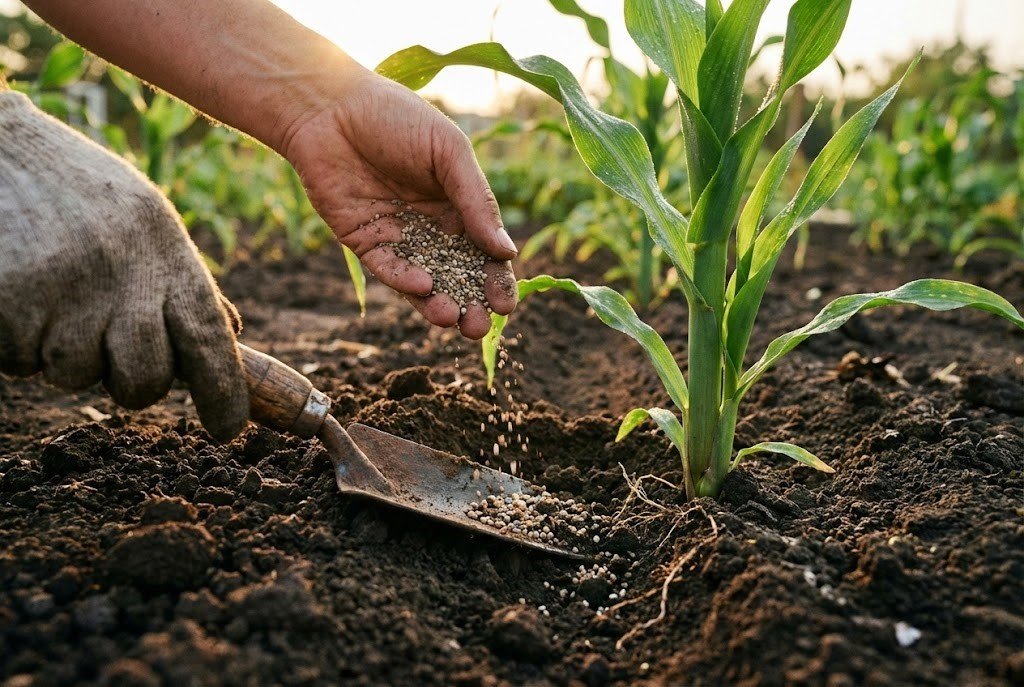
Applying fertilizer to growing corn is called “Side-Dressing.” Doing it wrong can kill your crop.
The Method
- Dig a Trench: Use a hoe to dig a shallow trench (1 inch deep) about 6 inches away from the base of the stalks.
- Apply: Sprinkle the calculated amount of fertilizer into this trench.
- Cover & Water: Cover the trench with soil and water immediately. This helps solid fertilizers break down and prevents nitrogen from evaporating into the air.
The Burn Warning
High-nitrogen fertilizers (like Urea or Ammonium Sulfate) are salts. If these granules land inside the whorl of leaves or touch the wet stalk, they will chemically burn the plant tissue, leaving white dead spots. Always aim for the soil, not the plant.
Frequently Asked Questions
Q: Can I use compost instead of fertilizer?
A: Compost is great for soil structure, but corn consumes nitrogen faster than compost releases it. For best results, use compost as a base and supplement with a concentrated nitrogen source like Blood Meal or Feather Meal.
Q: Why are the bottom leaves of my corn turning yellow?
A: This is the classic sign of Nitrogen Deficiency. The plant is cannibalizing nitrogen from the old leaves to support new growth. Use the “Knee-High” setting on the calculator and side-dress immediately.
Q: What is N-P-K?
A: It stands for Nitrogen, Phosphorus, and Potassium. Corn primarily needs the “N” (Nitrogen). A fertilizer like 46-0-0 (Urea) is pure nitrogen, while 10-10-10 is a balanced blend.