
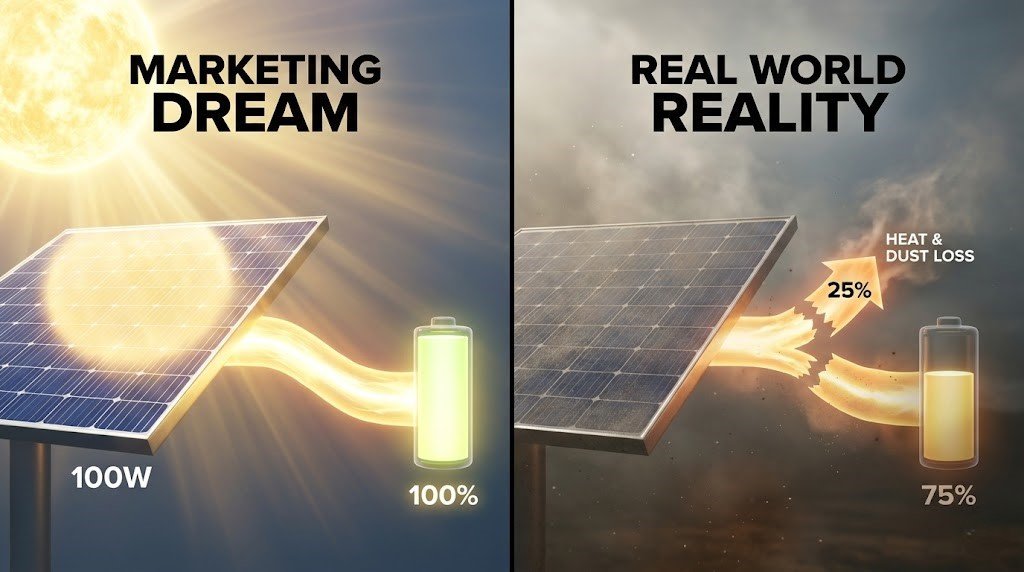
Calculating solar energy should be simple math, but real life gets in the way. If you buy a 100-watt panel and put it in the sun for 5 hours, you might expect 500 watt-hours of power. In reality, you will likely get closer to 375. Factors like heat, dust, wiring resistance, and charge controller inefficiency constantly eat away at your production.
Use our Solar Panel Output Calculator to cut through the marketing hype. We apply a realistic “System Efficiency Factor” to give you honest numbers for sizing your greenhouse, shed, or garden lighting system.
Solar Panel Output Calculator
How to Use the Solar Calculator
- Panel Wattage: The rated output of a single panel (e.g., 100W, 400W). This number is determined under “Standard Test Conditions” in a perfect lab.
- Number of Panels: The total count in your array.
- Sun Hours: This is NOT the length of the day. “Peak Sun Hours” refers to the number of hours per day the sun is at an intensity of 1000 watts per square meter.
- Example: In summer, you might have 14 hours of daylight, but only 5.5 Peak Sun Hours.
Why We Built This: The “75% Rule”
The “Secret Sauce” of our tool is the Efficiency De-rating. Most basic calculators just multiply Watts × Hours. We automatically strip away 25% of that number. Why?
- Heat Loss (-10%): Solar panels actually lose efficiency as they get hotter. A black panel baking in July produces less power than on a cool spring day.
- Inverter/Controller (-10%): Converting DC solar power to AC battery power is never 100% efficient.
- Dirt & Angle (-5%): Dust, pollen, and imperfect mounting angles reduce light absorption.
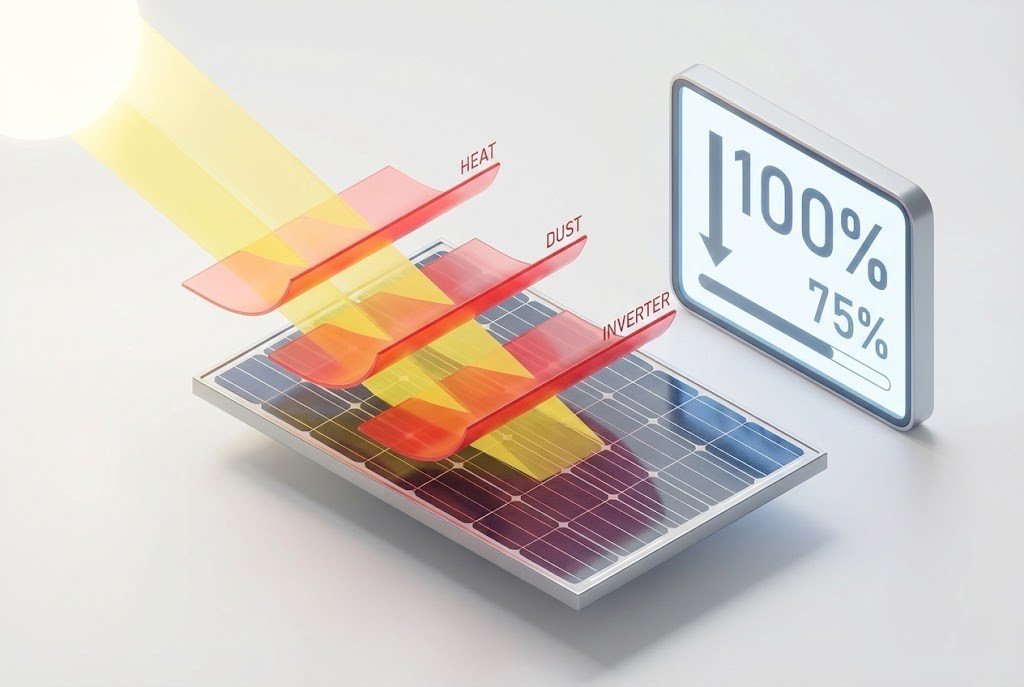
Our tool gives you the “Real World” number so your battery bank doesn’t run dry unexpectedly.
Educational Guide: Sizing Your System
To design a functional off-grid system, you must work backward from your needs.
1. Audit Your Load
List everything you want to power.
Example: A 20W LED light running for 5 hours = 100 Watt-hours (Wh) needed per day.
2. Calculate Production
Using our calculator, find out how many panels you need to hit that 100Wh target after losses. Always aim for 20% more production than you need to account for cloudy days.
3. Battery Storage
Your panels generate power during the day, but you likely use it at night. Ensure your battery bank (measured in Amp Hours or kWh) is large enough to store the Daily Output calculated by our tool.
Frequently Asked Questions
Q: What is a “Peak Sun Hour”?
A: It is a unit of measurement for solar intensity. One peak sun hour = 1 hour of sunlight at an intensity of 1,000 W/m². Early morning and late afternoon sun might only count as 0.5 peak hours.
Q: Will my panels work on cloudy days?
A: Yes, but output can drop to 10-25% of the rated capacity. This is why sizing your array based on “Real World” numbers (and adding a buffer) is critical for reliability.
Q: Should I wire panels in Series or Parallel?
A: Series increases voltage (good for long wire runs). Parallel increases amperage (good for shading issues). An MPPT charge controller is recommended to handle either configuration efficiently.