
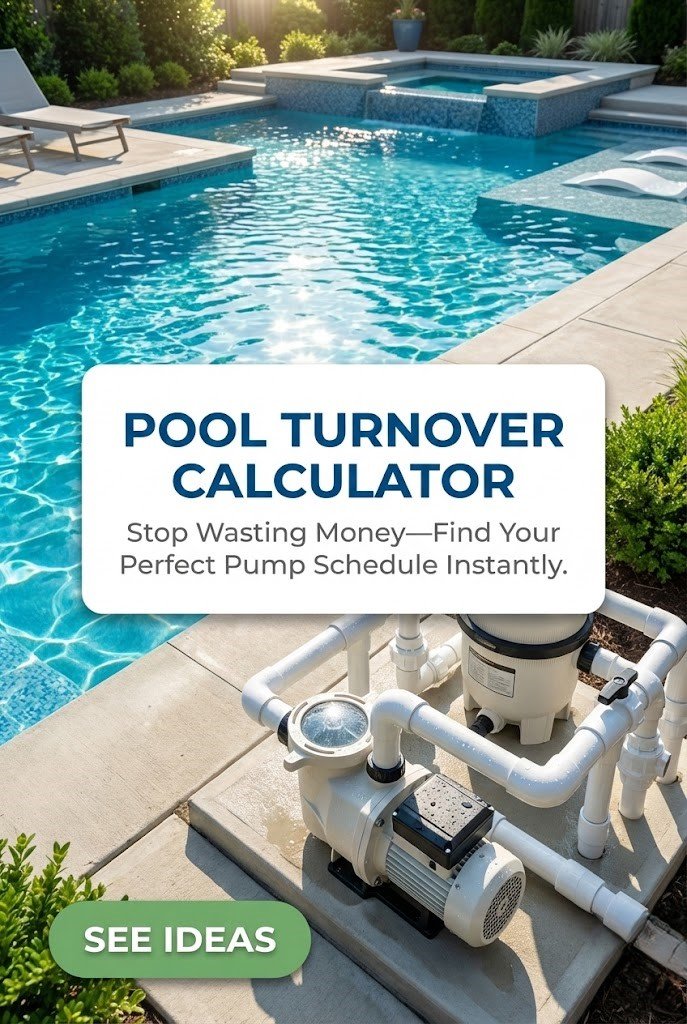
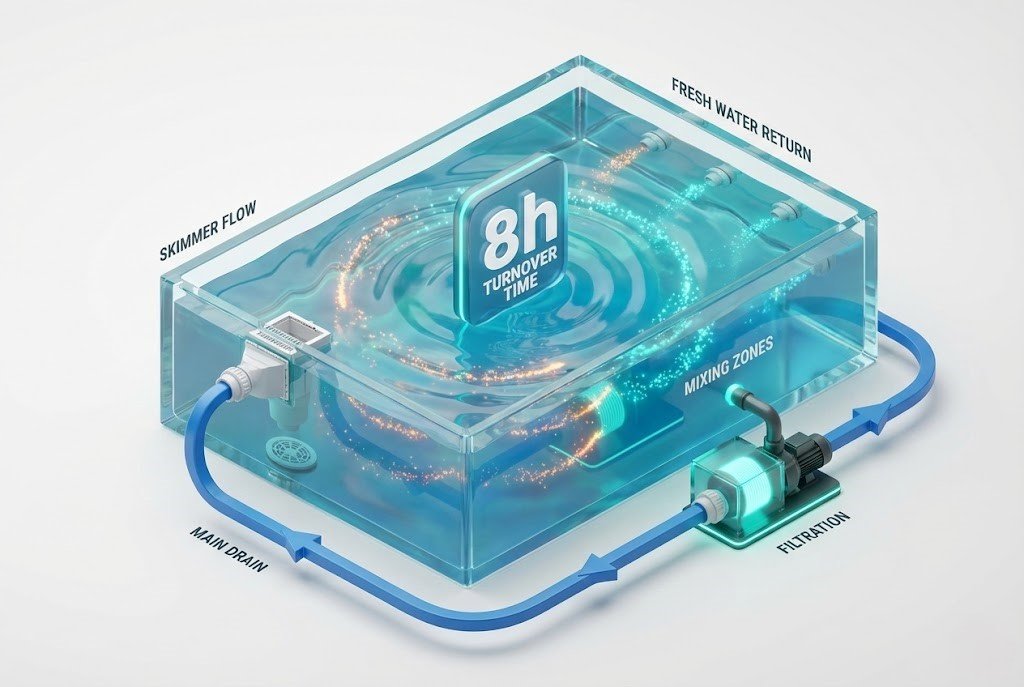
Crystal clear pool water isn’t just about chlorine; it’s about circulation. The “Turnover Rate” is the time it takes for your pump to cycle the entire volume of water in your pool through the filter. If this process takes too long, algae gets a foothold. If it happens too fast, you might be wasting hundreds of dollars a year on unnecessary electricity.
Use our Pool Turnover Calculator to find the “sweet spot” for your pump schedule. By balancing your pool’s volume with your pump’s flow rate (GPM), you can ensure proper filtration without running your equipment 24/7.
Pool Turnover Calculator
How to Use the Turnover Calculator
- Pool Volume: Enter the total capacity of your pool in gallons. If you don’t know it, calculate: Length × Width × Avg Depth × 7.5.
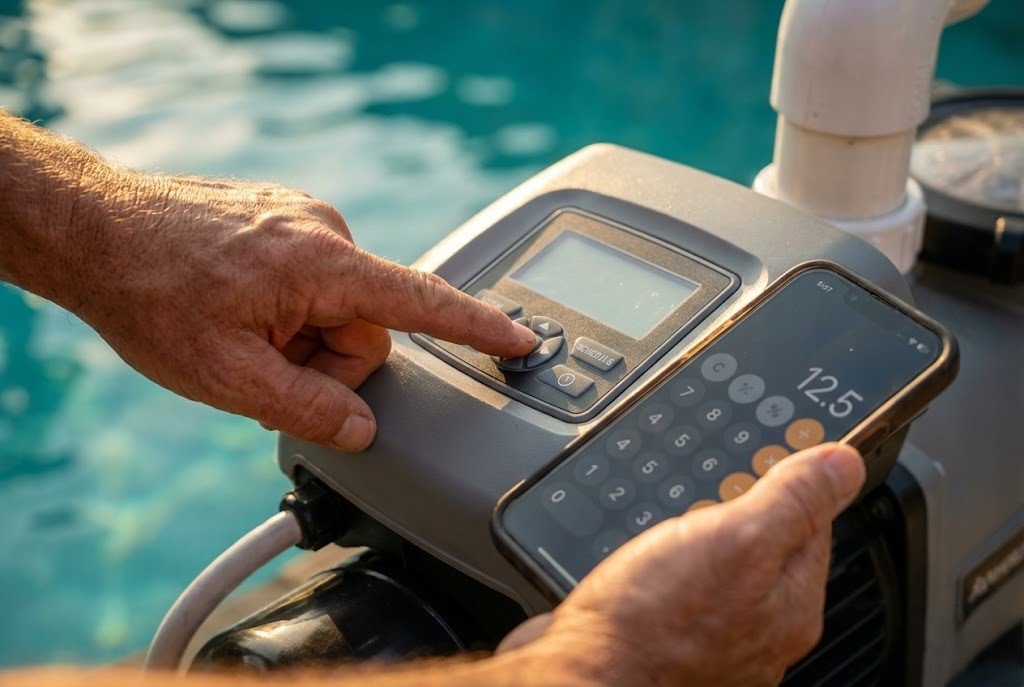
- Pump Flow Rate (GPM): Gallons Per Minute. You can find this on the pump’s manufacturer label, or estimate based on your horsepower (e.g., 1 HP ≈ 40-60 GPM depending on plumbing).
- Target Turnover: The industry standard is 8 hours for one complete cycle. In peak summer heat, you may want to achieve this faster; in winter, you can cycle slower.
Why We Built This: The “Variable Speed” Advantage
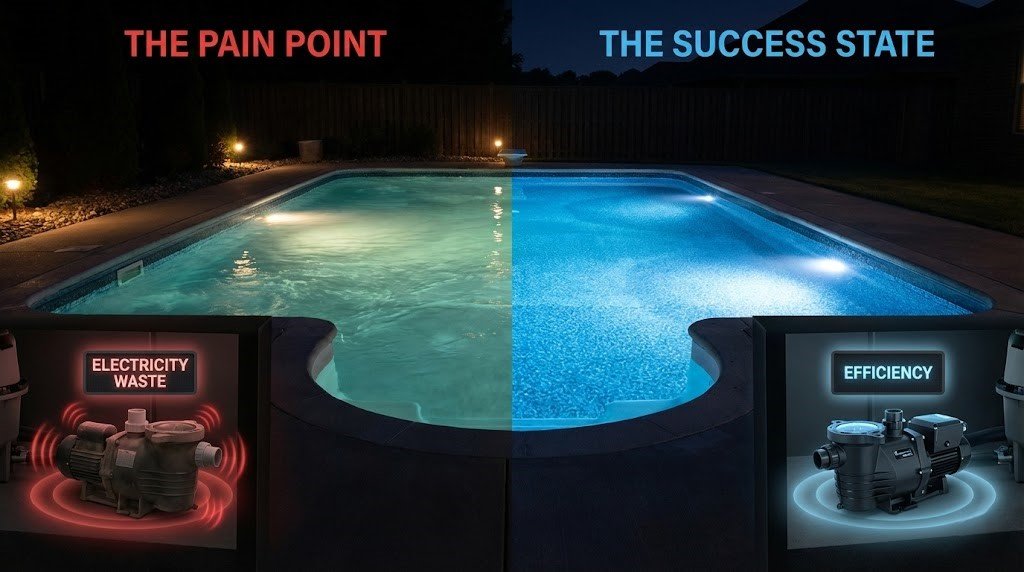
The “Secret Sauce” of our tool is the efficiency diagnosis. Old-school single-speed pumps run at full power all the time, often cycling the water much faster than necessary and wasting energy. Our tool compares your current runtime to the ideal 8-hour window. If you find your pump completes a turnover in just 4 hours, you are essentially paying double for electricity.
Switching to a Variable Speed Pump allows you to dial down the GPM to match the exact 8-hour target, saving up to 90% on energy costs.
Educational Guide: Pool Circulation 101
Water that moves is healthy; water that sits is stagnant. Circulation distributes chemicals evenly and pushes debris into the skimmer before it sinks.
What is a Good Turnover Rate?
Most residential pools aim for one turnover every 8 to 12 hours.
- Summer: 1 to 1.5 turnovers per day (Run pump 8-12 hours).
- Winter: 0.5 to 1 turnover per day (Run pump 4-6 hours).
Running the pump longer than necessary doesn’t make the water cleaner—it just wears out your motor.
Calculating Volume for Irregular Pools
If your pool is kidney or freeform shaped, use averages.
Formula: Avg Length × Avg Width × Avg Depth × 7.5
Tip: Always round up. It is better to slightly overestimate volume than to under-filter.
Frequently Asked Questions
Q: How do I find my pump’s GPM?
A: It’s tricky because it depends on pipe resistance (Head Pressure). However, a general rule of thumb is: 3/4 HP = 40 GPM, 1 HP = 50 GPM, 1.5 HP = 70 GPM. A flow meter installed on the pipe is the only 100% accurate way to know.
Q: Should I run my pump at night or day?
A: Run it during the day. The UV rays from the sun burn off chlorine quickly. Circulating the water during peak sun hours ensures chlorine is constantly mixed and distributed to fight algae when it’s most active.
Q: Can I run my pump 24/7?
A: You can, but it’s usually overkill unless you have a low-flow variable speed pump running at a very low RPM (which is extremely energy efficient). For single-speed pumps, 24/7 is a waste of money.