
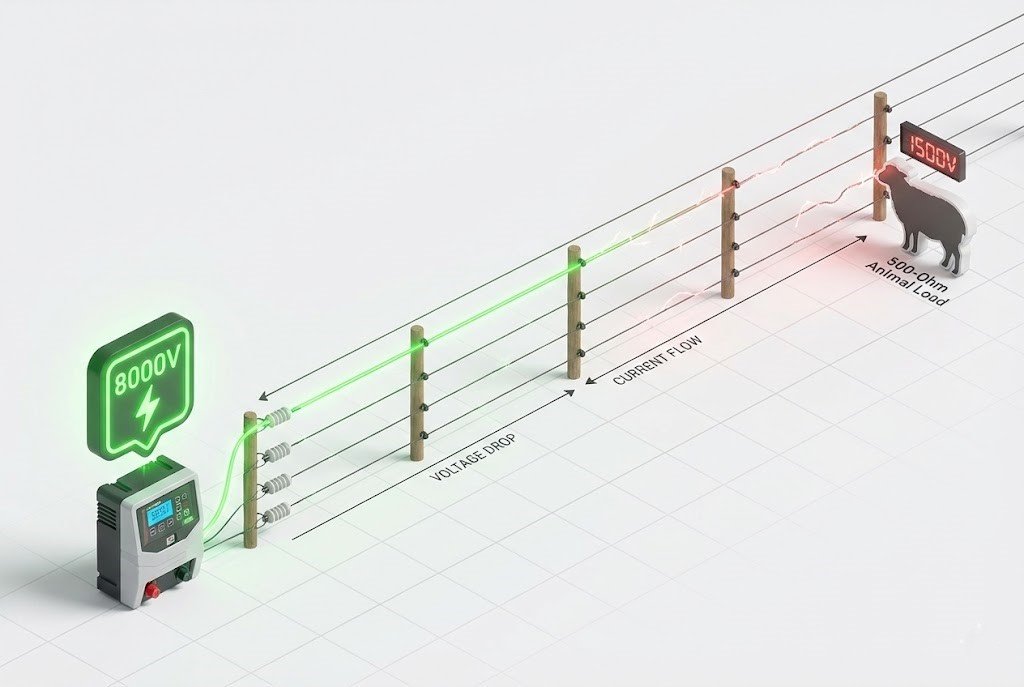
Building an electric fence is about more than just stringing wire; it is about physics. The longer your fence, the more resistance the electricity faces as it travels down the line. This “Voltage Drop” means that while your energizer might be pumping out 8,000 volts at the barn, you might only have 1,500 volts at the far corner of the pasture—leaving you with escaped cattle and a broken fence.
Use our Electric Fence Voltage Drop Calculator to estimate the effective shock at the end of your run based on your wire type, distance, and energizer output.
Electric Fence Calculator
How to Use the Electric Fence Calculator
- Wire Material: Select your specific wire. This is the most critical factor. Aluminum wire conducts electricity nearly 3x better than steel, while standard “Polywire” has extremely high resistance and is only suitable for short runs.
- Fence Length: The total distance of the electrified wire from the energizer to the furthest point.
- Energizer Output: Check the sticker on your charger (measured in Volts or kV). Most units output between 6,000V and 10,000V under load.
Why We Built This: The “Secret Sauce” of Shock Factor
The “Secret Sauce” of our tool is the Animal Load Logic. A fence isn’t a closed circuit until an animal touches it. Our calculator simulates the physics of a 500-ohm load (a standard animal) touching the fence at the very end of the line. It calculates the voltage divider effect to tell you exactly how much “punch” is left after the current has fought through miles of wire resistance.
We also categorize the result by livestock type—because a 2,000V shock might stop a horse, but a thick-wooled sheep won’t even feel it.
Educational Guide: Optimizing Your Fence
If your calculation shows a weak voltage at the end of the line, you have three variables to fix: Grounding, Wire, or Connections.
1. Wire Selection Matters
Resistance is the enemy. It is measured in Ohms per mile.
- 12.5 ga Aluminum: ~20 Ohms/mile (The Gold Standard)
- 12.5 ga Steel: ~56 Ohms/mile (Industry Standard)
- Polywire (6-strand): ~6,000+ Ohms/mile (Only for temporary grazing)
Trying to push electricity through 1 mile of Polywire is like trying to push water through a coffee straw. You will lose almost all your pressure (voltage).
2. The Grounding System
The most common cause of fence failure isn’t the wire—it’s the ground rods. The electricity must travel from the animal’s feet, through the dirt, back to the ground rods to complete the circle. For most energizers, you need a minimum of three 6-foot galvanized ground rods spaced 10 feet apart.
3. The “Weed Load”
Wet grass touching the bottom wire creates a “short,” draining voltage into the earth before it ever reaches the animal. This is called a “parasitic load.” If your voltage is consistently low, walk the line and trim any vegetation touching the wires.
Frequently Asked Questions
Q: How many volts do I need for cattle?
A: For cattle, a minimum of 3,000V is recommended. For bulls or aggressive animals, aim for 5,000V+.
Q: Why is my fence shocking me but the tester says 0V?
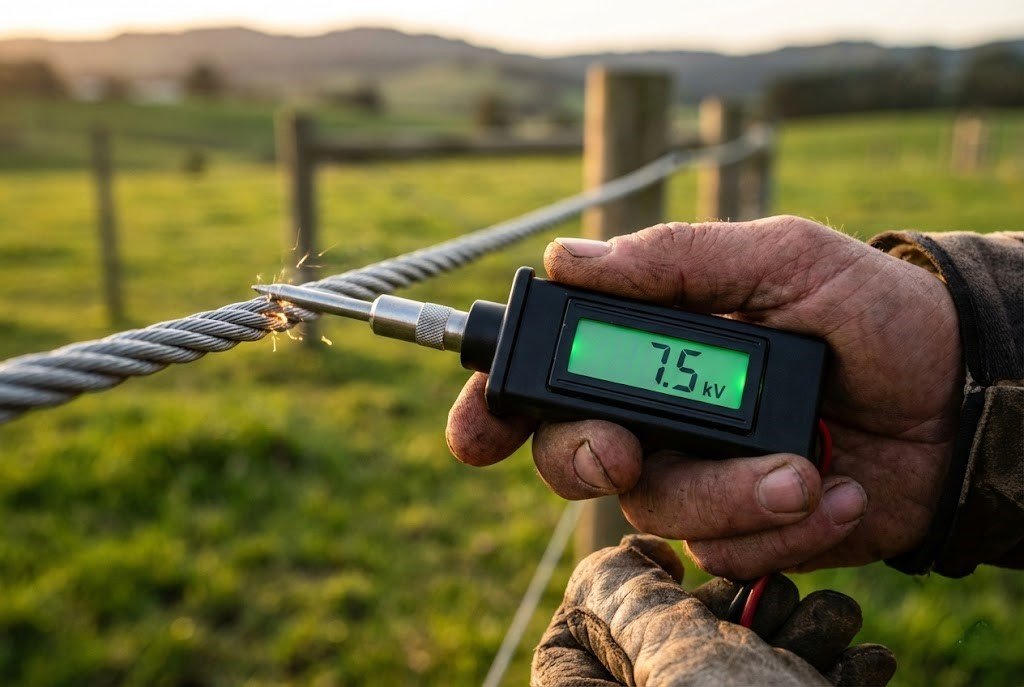
A: Cheap testers can fail, or the pulse is too intermittent. However, if you feel a shock but the voltage is low, it means you have high voltage but very low amperage (current), often due to high resistance in the wire.
Q: Can I connect ends of the fence to make a loop?
A: Yes! Creating a “loop” significantly reduces voltage drop because electricity can travel in two directions to reach the fault, effectively cutting the resistance in half.