
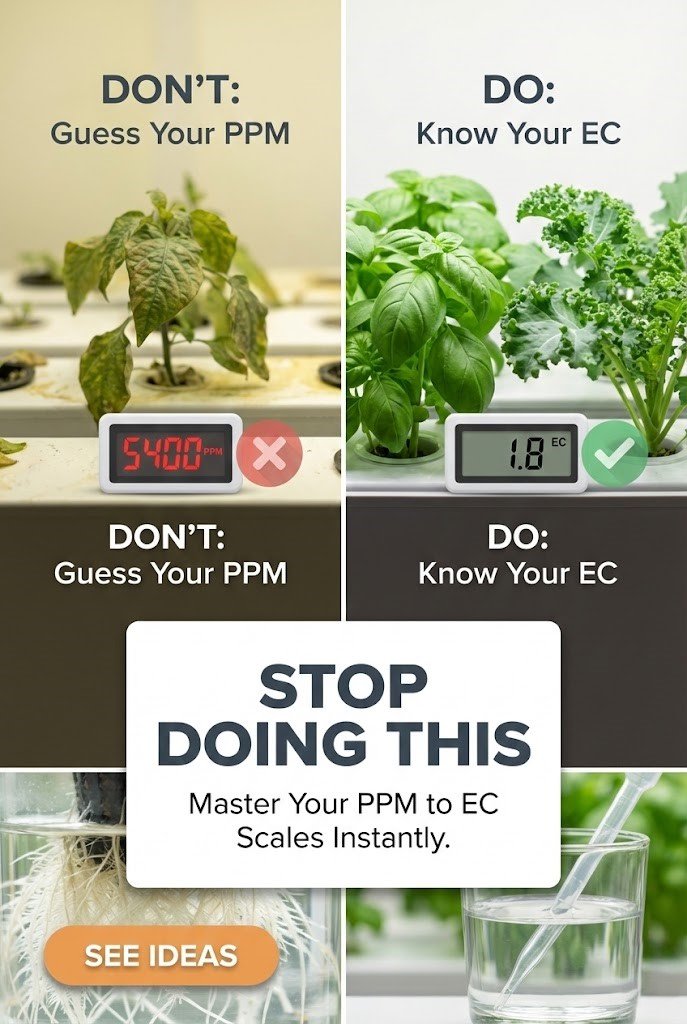
In the world of high-performance gardening, feeding your plants isn’t just about mixing “a scoop of fertilizer.” It is about managing the concentration of dissolved minerals in your water. The problem? Half of the tools on the market measure in Electrical Conductivity (EC), while others use Parts Per Million (PPM). Even worse, there are two different PPM scales (500 and 700), meaning a reading on one pen could be completely different on another pen despite being in the same bucket of water.
Our PPM to EC Converter solves this universal frustration. By providing the correct conversion factors for Hanna, Milwaukee, and Bluelab meters, you can follow any nutrient recipe with 100% confidence that you aren’t starving or scorching your crops.
PPM & EC Nutrient Converter
How to Use the PPM to EC Converter
- Reading Value: Enter the number currently displayed on your meter.
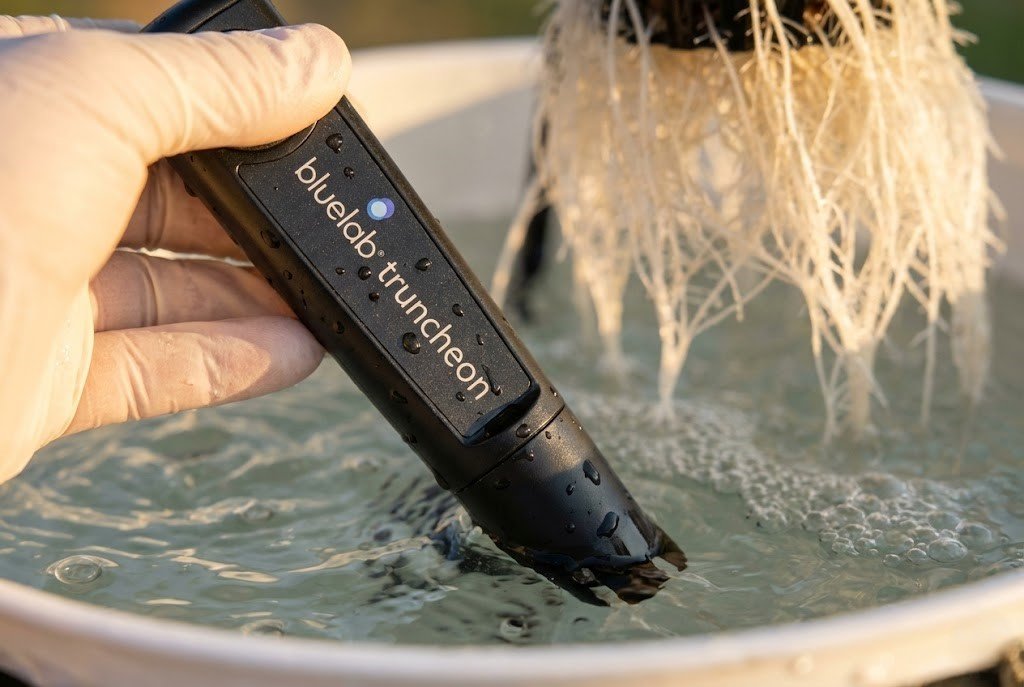
- Measurement Unit: Select the unit your meter uses. If you are using PPM, you must know your meter’s conversion scale (Hanna vs. Truncheon).
- Check Results: The tool will instantly display the value across all three common scales and provide a nutrient safety check.
Why We Built This: Solving the “Scale Confusion”
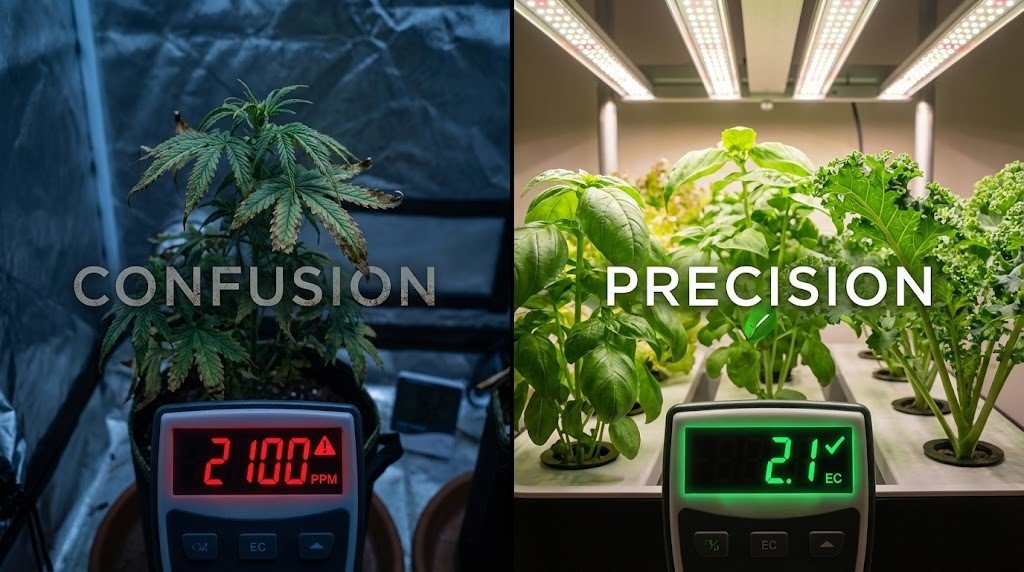
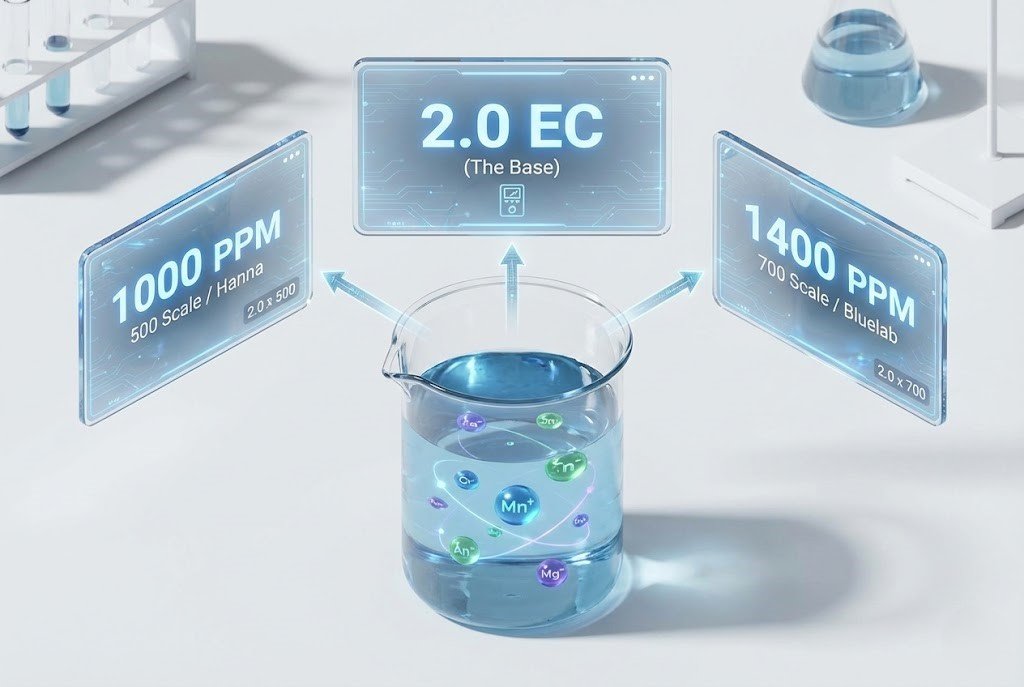
The “Secret Sauce” of our tool is the Brand Match Logic. Most gardeners don’t know if their pen is a 500-scale or a 700-scale. If you use a Bluelab pen (700 scale) but follow a guide written for Hanna meters (500 scale), you will accidentally underfeed your plants by 40%. Our tool explicitly matches brands to scales: Bluelab uses 700; Hanna and Milwaukee use 500.
We also included a Nutrient Burn Warning. Once your EC passes 3.0, the osmotic pressure becomes so high that your plants can no longer “drink,” leading to sudden death—our tool flags this risk immediately.
Educational Guide: EC vs. PPM
Technically, digital meters can only measure one thing: EC (Electrical Conductivity). Pure water doesn’t conduct electricity, but the minerals in fertilizer do. The more fertilizer you add, the higher the EC.
The PPM Conversion Problem
Since gardeners found EC numbers (like 1.8) hard to remember, manufacturers created PPM. However, there is no physical way to measure PPM directly; the meter simply takes the EC reading and multiplies it by a “guess factor.”
- 500 Scale (NaCl): Assumes the conductivity is similar to sodium chloride. Standard for Hanna.
- 700 Scale (442): Assumes a mix of salts common in well water. Standard for Bluelab/Truncheon.
Ideal Ranges for Garden Success
Most leafy greens (lettuce, herbs) thrive at an EC of 0.8 to 1.2. Flowering plants like tomatoes or peppers need more energy, usually ranging from 1.8 to 2.5. Use this calculator to ensure you are hitting these “sweet spots” without crossing into the toxic zone.
Frequently Asked Questions
Q: Which scale is more accurate, 500 or 700?
A: Neither. They are both mathematical estimates of the base EC reading. The only “true” universal measurement is EC. This is why commercial growers almost exclusively use EC (mS/cm).
Q: What should I do if my EC is too high?
A: Add “Plain Water” (pH balanced) to your reservoir. This dilutes the concentration of salts and lowers the EC. Never add more fertilizer to a high-EC solution.
Q: Does temperature affect the reading?
A: Yes. Most modern pens have ATC (Automatic Temperature Compensation), but for the best accuracy, ensure your reservoir water is between 65°F and 72°F when testing.