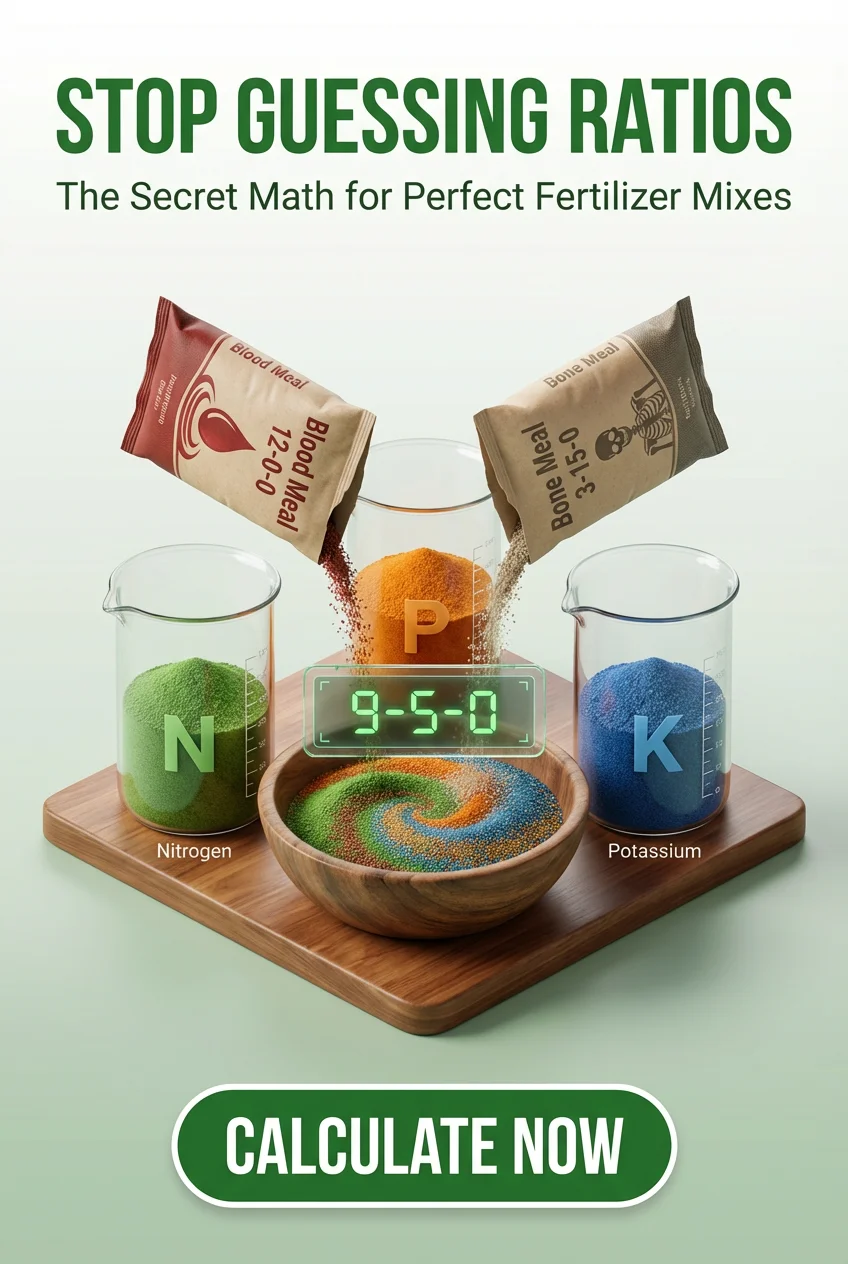
Every gardener eventually accumulates a collection of half-empty fertilizer bags. You have some Blood Meal (12-0-0) left over from spring, and a bag of Bone Meal (3-15-0) from fall. Can you mix them? And if you do, what are you actually feeding your plants?
🧪 NPK Value Mixer

Mixing fertilizers is a great way to create a custom "All-Purpose" blend or use up leftovers, but you need to get the math right. Too much Nitrogen can burn your plants; too little Phosphorus leads to weak roots. Use our NPK Value Mixer below to calculate the exact ratio of your custom blend.
How to Use This Tool
This tool performs a "Weighted Average" calculation based on the pounds you add:
- Fertilizer A: Enter the N-P-K numbers from the first bag (e.g., 10-10-10) and how many pounds you are adding.
- Fertilizer B: Enter the numbers from the second bag (e.g., 46-0-0 Urea) and the weight.
- Calculate: The tool instantly tells you the final N-P-K ratio of your new pile.
Why We Built This (The "Secret Sauce")
Most people assume that if you mix a 10-10-10 and a 20-20-20, you get a 30-30-30. That is wrong. You actually dilute the stronger fertilizer with the weaker one.
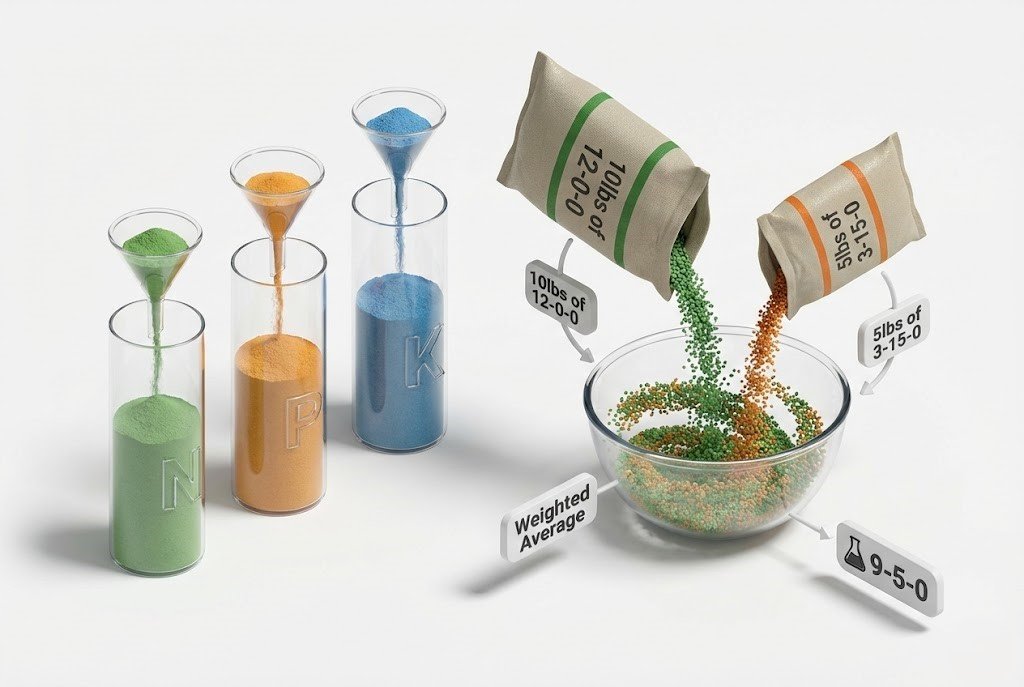
The Math of Dilution:
If you mix 50 lbs of sand (0-0-0) with 50 lbs of strong fertilizer (20-20-20), you now have 100 lbs of material, but the same amount of nutrients. Your final result is actually 10-10-10. Our calculator handles this weighted dilution logic automatically so you don't underfeed your garden.
Educational Guide: Understanding N-P-K
These three numbers are the "Macronutrients" essential for plant life.
1. Nitrogen (N) – The Leaf Builder
The first number. Nitrogen fuels lush, green, leafy growth.
High N Needs: Lawns, corn, leafy greens (lettuce, spinach).
Symptoms of Deficiency: Yellowing older leaves.
2. Phosphorus (P) – The Root & Bloom Builder
The second number. Phosphorus is critical for root development, flowers, and fruit set.
High P Needs: Bulbs, root vegetables (carrots), and flowering shrubs.
Symptoms of Deficiency: Stunted growth, purple veins in leaves.
3. Potassium (K) – The General Manager
The third number. Potassium helps plants move water and nutrients around. It improves disease resistance and heat tolerance.
High K Needs: Tomatoes, potatoes, and fruit trees.
Symptoms of Deficiency: Brown scorching on leaf edges.
Frequently Asked Questions
Can I mix organic and synthetic fertilizers?
Technically yes, but it isn't recommended. Synthetic fertilizers (like blue crystals) are fast-acting salts that can kill the beneficial microbes in organic fertilizers (like manure). It is better to apply them separately or stick to one type.
What is a "Balanced" fertilizer?
A balanced fertilizer has equal numbers, like 10-10-10. This is a good "fail-safe" for most gardens. However, most soils already have enough Phosphorus, so many agronomists recommend a 3-1-2 ratio (like 15-5-10) for general maintenance.
What if one of my numbers is 0?
That's fine! Many specific amendments are single-nutrient sources. Urea is 46-0-0. Potash is 0-0-60. You can use this calculator to mix them together to create a complete fertilizer.