
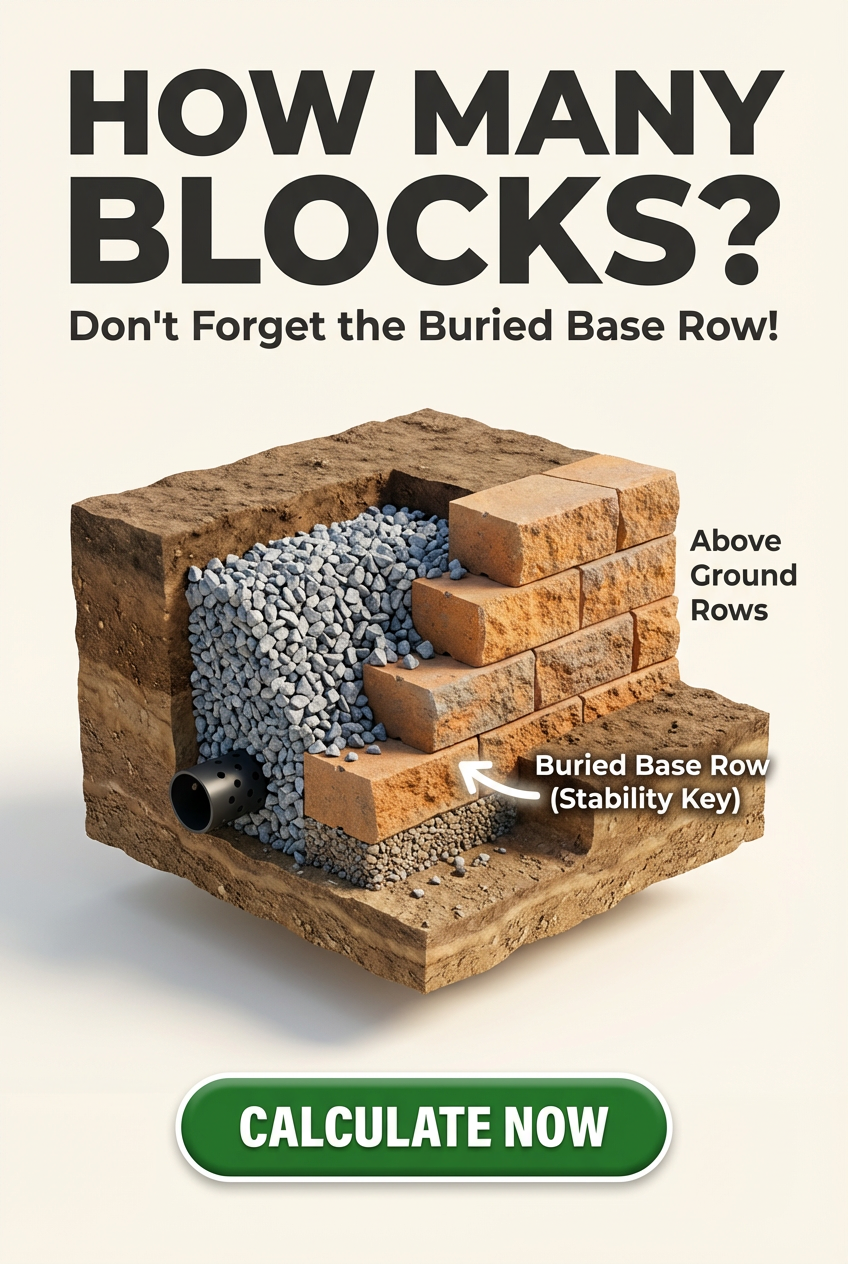
Building a retaining wall is a significant investment in both labor and materials. Whether you are leveling a sloped yard, creating a raised planter, or holding back soil erosion, knowing exactly how many blocks to order is crucial. Ordering too few stalls your project; ordering too many wastes money.
Use our free Retaining Wall Calculator below to determine the exact number of wall blocks and capstones needed. It automatically accounts for the “buried base course” to ensure your wall is structurally sound.
Retaining Wall Calculator
Estimate blocks needed for sturdy garden walls
How to Use This Calculator
Estimating a retaining wall involves more than just length times height. Here is how to measure correctly:
- Wall Length (Feet): Measure the total linear distance of the face of the wall. If the wall curves, use a flexible tape measure or a garden hose to trace the path and measure the hose.
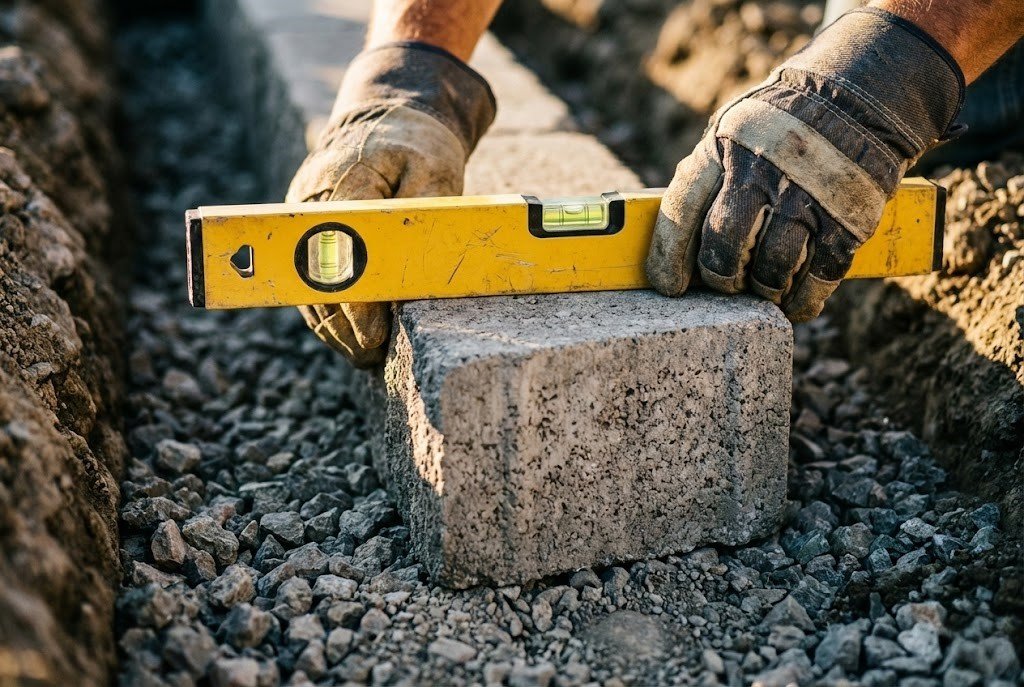
- Visible Height (Feet): Measure how high you want the wall to be above the ground. Do not include the buried section in this number—our calculator handles that automatically.
- Block Size: Enter the Length and Height of the specific block face you are buying. Common sizes are 12"x6" or 16"x6".
- Capstones: Toggle "Include Capstones" if you plan to finish the top of the wall with flat trim blocks.
Why We Built This (The "Secret Sauce")
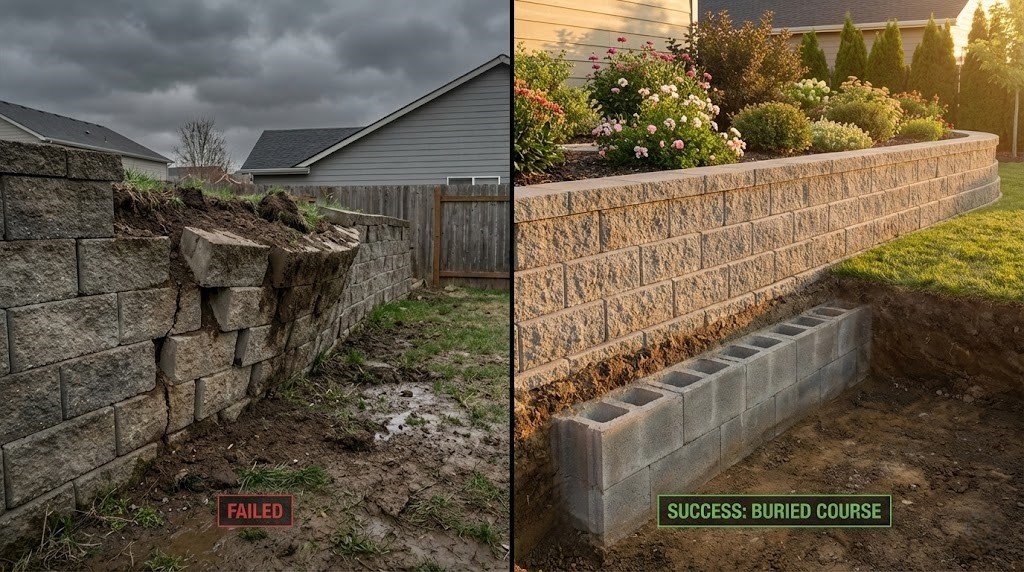
Many online calculators fail because they only calculate the visible wall. If you build a wall sitting directly on top of the grass, it will eventually tip over.
The "Buried Row" Safety Factor:
For a retaining wall to be stable, the bottom row of blocks (the base course) must be partially or fully buried in the ground. Our tool automatically adds one extra row of blocks to your total count to account for this buried foundation layer. It also adds a 5% waste margin for cutting blocks at the ends.
[Image of retaining wall cross section drainage]
Educational Guide: Drainage is Key
The #1 reason retaining walls fail is not bad blocks—it's water pressure (hydrostatic pressure). When wet soil pushes against the back of the wall, it can cause it to bulge or collapse.
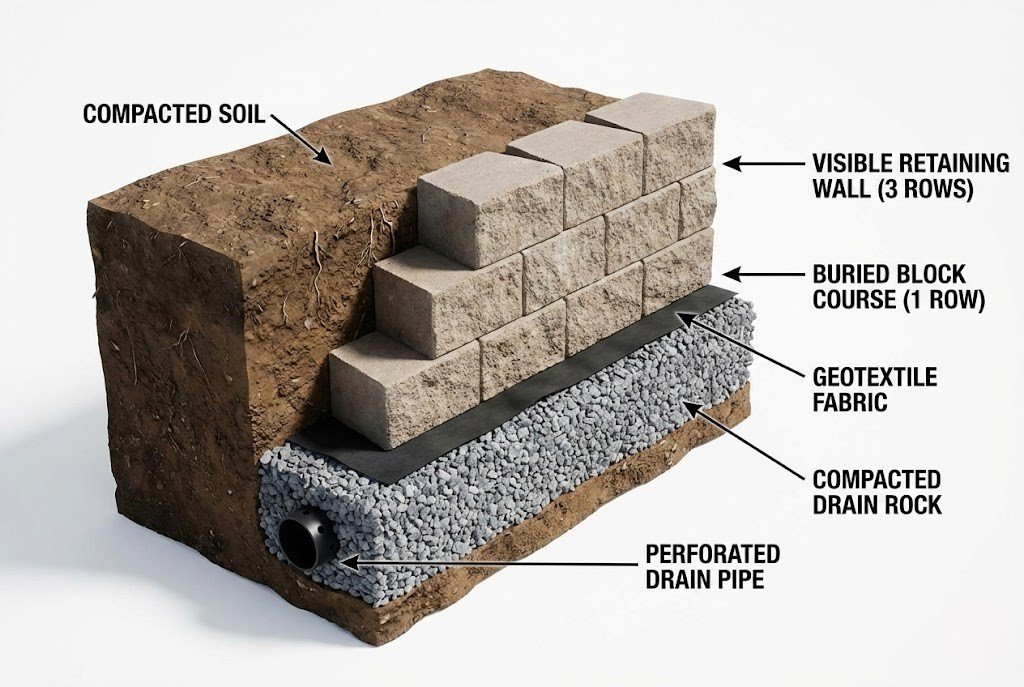
To prevent this, you must install:
- Drainage Pipe: A 4-inch perforated pipe behind the base of the wall.
- Drain Rock: Backfill the space directly behind the blocks with 12 inches of clean gravel (not dirt!). This allows water to flow down to the pipe rather than pushing on the wall.
- Filter Fabric: Separate the gravel from the soil with landscape fabric to keep the gravel from getting clogged with dirt.
Frequently Asked Questions (FAQ)
How high can I build a retaining wall without an engineer?
In most municipalities, you can build a retaining wall up to 3 or 4 feet high without a permit or engineering. If your wall exceeds 4 feet, you typically need a structural engineer to design it and verify the reinforcement (geogrid).
Do I need concrete for a retaining wall base?
For segmented block walls (dry stack), you do not use poured concrete. Instead, you use a compacted gravel base (paver base). This allows the wall to flex slightly with ground movement (freeze/thaw cycles) without cracking.
What is Geogrid and do I need it?
Geogrid is a plastic mesh reinforcing fabric placed between layers of blocks and extending back into the soil. It anchors the wall into the earth. You generally need Geogrid for any wall taller than 3 feet or if the wall is holding back a heavy load (like a driveway).